

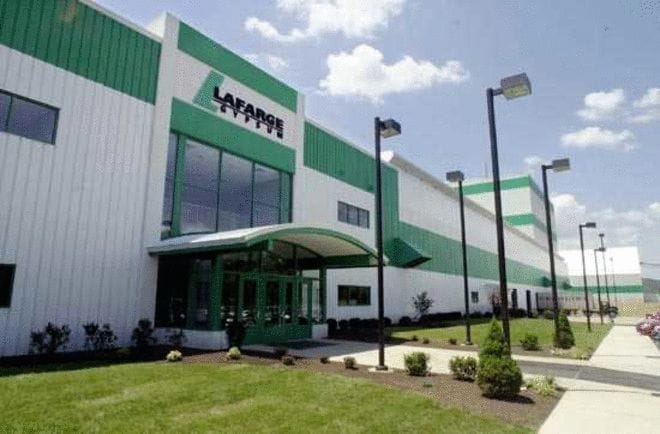
Lafarge: Balance Sheet Restructuring, Volume Growth Drive Earnings
Lafarge Africa Plc. (WAPCO) 9-month of financial year 2020 showed that revenue performance turned out to be stronger when compare with the corresponding period last year.
Unhindered by setbacks from the COVID-19 containment measures in Q2-2020, the cement company’s revenue increased 10.32% from ₦163.06 billion in 9M-2019 to ₦179.88 billion.
In its equity note, Meristem Securities Limited noted that the impressive outing was due to significant growth of 29.7% in sales volume in the quarter.
Although revenue from aggregates and concretes slipped by 29.86%, its effect was cushioned by an 11.45% jump in cement revenue which accounts for 98% of total revenue.
“As the company continues to push for a larger market share by strengthening its distribution network, we expect to see volumes growth in subsequent quarters.
“We are also optimistic about the prospect of the cement market in Nigeria.
“We anticipate that cement makers would continue to enjoy robust demand driven by the existing infrastructure gap and the recognition of concrete-based roads as a viable alternative to asphalt”, Meristem Securities stated.
For 2020, analysts forecast that the company total turnover will hit ₦230.42 billion- compared to previous forecast of ₦216.48 billion.
It based the estimate on a revised capacity utilization of 57% as against 54% previously driven by increased demand.
This represents a growth of 8.18% when compared to ₦213.00 billion in 2019 amidst challenging operating environment.
Lower Finance Costs Boosts Bottomline Performance
On the financing side, analysts explained that during the period, the company continued to intensify efforts on cost optimization under its Health, Cost and Cash Initiative.
So far, the result has been a reduction in the cost to sales ratio from 69.11% in 9M-2019 to 68.80% in 9M-2020 and a slightly lower operating expenses to sales ratio of 8.78% from 9.50% in 9M-2019.
Although the company was able to reduce costs of production and overheads, analysts said the cost implications of the FX devaluation, especially on energy costs is high.
Like its peers, Meristem expects FX stability to be a key risk factor to put pressure on costs.
However, topline gains and overall cost moderation ensured a slightly higher operating margin of 22.85% in 9M-2020 compare to 21.80% in 9M-2019.
Supported by a 54.51% decline in finance cost (a fall out of lower debt obligation as a result of the restructuring in 2019), profit after tax grew by 37.05% to ₦28.20 billion in 9M-2020 from ₦20.57 billion in the comparable period in 2019.
Balance Sheet Health Unfazed by Pandemic
In H1:2020 update, Meristem Securities assessment of the company’s balance sheet showed WAPCO will be in good financial health following the divestment of the South African subsidiary.
As at 9M-2020, the investment firm said it views remains unchanged.
Having preserved liquidity through the pandemic, proved resilient to the effect of the pandemic.
The company’s liquidity position as observed showed current ratio of 0.83x as against 0.89x in 2019 and cash ratio printed at 0.49x compare to 0.32x in 2019.
This is also true when viewed in comparison to peers like BUACEMENT with 0.62x and cash ratio of 0.44x and alongside the industry norm of working capital deficits.
Lafarge WAPCO’s free cash flow also improved by 94.50% year on year to ₦50.60bn during the period given the company’s modest capital expenditure and improved earnings.
“In our opinion, these coupled with impressive return to shareholders that printed at 34.38% against 33.37% in 2019 and decent gearing (0.15x) highlight the company’s financial strength”, Meristem Securities explained.
For 2020, the firm revised EBITDA forecast from ₦65.97 billion to ₦68.48 billion and maintain a target enterprise value to EBITDA of 4.51x.
Analysts at Meristem Securities said they thereby arrived at a 2020 price target of ₦19.88.
At the reference price of ₦18.50, the implied upside of 7.46% (relative to our 2020 target price of ₦19.88) which then informed Meristem’s HOLD rating on the counter.
Chapel Hill Denham in its equity note explained that revenue growth and balance sheet restructuring were key to the company’s earnings in the period.
The firm explained that WAPCO’s annualised earnings per share (EPS) expanded by 37.1% year on year in 9M-20, mostly stemming from a volume-led expansion in revenue and a significant 54.5% decline in finance charges.
Both of which dovetail with analysts’ expectation.
However, Chapel Hill Denham stated at ₦2.33, the reported EPS still marginally trail 2020 forecast of ₦2.47, on an annualised basis.
Revenue bounced back from COVID-19 induced declines in Q2-20, notching higher by 31.4% year on year in Q3-20 relative to Q3-19.
“While we do not downplay the impact of the recent favourable pricing environment, we believe the revenue growth was driven by sharper volume growth, going by attribution analysis”, Chapel Hill Denham expressed.
Supporting the assertion, WSTC Securities also attribute the revenue growth in Q3-2020 to higher prices during the period.
“We believe that the exchange rate devaluation, which affected the cost of major industry players, resulted in an industry trend of a price increase.
“From our research, we observed price increases in some competitors’ products. Given that Lafarge is a price taker in the industry, we posit that a price increase possibly took place to protect margins”, WSTC explained.
Explaining further, analysts at Chapel Hill Denham noted that stronger economic recovery and robust private sector demand must have aided cement consumption in Q3, a move which Lafarge benefitted from.
Sequentially, revenue grew by 4.4% year on year. This is amid the traditional rainfall season in July-Sept, which has historically weighed on sales.
“For evidence, our channel checks suggest that cement demand has recovered from the COVID-19 downturn in Q2-2020”, Chapel Hill Denham stated.
As expected, analysts said Lafarge continues to benefit from what now appears to be a deleveraged balance sheet.
Notably, as with the previous quarter, gross borrowings declined further by 18.1% year on year in 9M-19, paving the way for 54.5% and 4.2% fall in finance charges in 9M-20 and Q3-20 respectively.
The positive pass-through impact of that is a 2.8% year on year growth in profit after tax expenses in Q3-2020.
Its net operating cash flow came stronger in Q3-2020, growing more than two-fold year on year to ₦28.72 billion.
“This, in our view, was a fall out of better working capital management”, analysts explained.
Precisely, the group reported ₦2.09 billion and ₦3.10 billion decline in inventory and trade receivables, both of which underpinned cash generation during the period.
“Elsewhere, in its renewed strategy of preserving cash, especially in the face of the COVID-19 pandemic, we like the moderation in Lafarge’s CAPEX intensity to 1.9% in Q3-20, from 12.8% in Q3-19”, Chapel Hill Denham stated.
On a 9M-20 basis, the company’s capital expenditure (CAPEX) intensity is now trailing the prior year, with 9M-2020 CAPEX intensity reported at 3.5%, from 8.5% in 9M-19.
Explaining its concerns about the results, Chapel Hill Denham stated that although Q3-2020 earnings before interest tax depreciation and amortisation (EBITDA) narrowly grew by 0.9% year on year, related margin declined significantly by 8.3 percentage points.
This happened as cost of goods sold 36.5% growth ran ahead of 31.4% revenue growth.
On cost of goods sold, analysts explained that the pressure emanated from variable cost which rose 61.2% while production cost expanded 66.4% year on year, both of which offset slower maintenance cost of 26.4%.
“While management had downplayed the impact of Naira depreciation on input cost during our last engagement, we believe the cost of goods sold growth is reflective of FX losses, induced by movement in energy prices”, analysts said.
Chapel Hill Denham said the firm retains BUY rating on Lafarge with a 12-month target price of ₦31.11.
Meanwhile, analysts at WSTC Securities believe that largely, WAPCO’ earnings was strongly supported by its balance sheet deleveraging efforts.
It said the Group’s total borrowings declined by 16% on a year on year basis, from ₦65.27 billion as of 9M-2019 to ₦54.95 billion as of 9M-2020.
“Analysts noted that the restructuring exercise done by the Group in its previous financial year, wherein equity capital was injected to deleverage the balance sheet and extinguish its foreign currency loans helped the result.
In Q3-2020, the exercise paid off, as finance cost lowered by 4% from ₦3.25 billon in Q3-2019 to ₦3.11 billion in Q3-2020.
Meanwhile, finance income increased by 82%, from ₦188.98 million in Q3-2019 to ₦344.39 million in Q3-2020.
WSTC Securities attributed that the higher finance income to a higher cash balance in Q3-2020.
Therefore, profit before tax grew by 18% year on year from ₦4.69 billion in Q3-2019 to ₦5.53 billion in Q3-2020.
Profit after tax grew by just 3% from ₦4.73bn in Q3-2019 to ₦4.87 billon in Q3-2020, due to an effective tax charge in Q3-2020 relative to a tax credit in Q3-2019.
“Our earnings projections are still on track, as we expect to see a 2020 EPS of N2.18. We also expect the Group to declare a ₦1.50 dividend.
“We revise our cash flow projections upwards to reflect an improved outlook of business fundamentals and earnings”, WSTC Securities stated.
Consequently, the firm’s fair value estimate was revised upwards to ₦19.21.
At the market price of ₦18.00, the stock offers a 15% total return, both price return and dividend yield. Therefore, analyst at WSTC Securities maintain BUY recommendation.
Read Also: Lafarge: Analysts Cut Target Price on Post-COVID-19 Competition Concern
Lafarge: Balance Sheet Restructuring, Volume Growth Drive Earnings
