

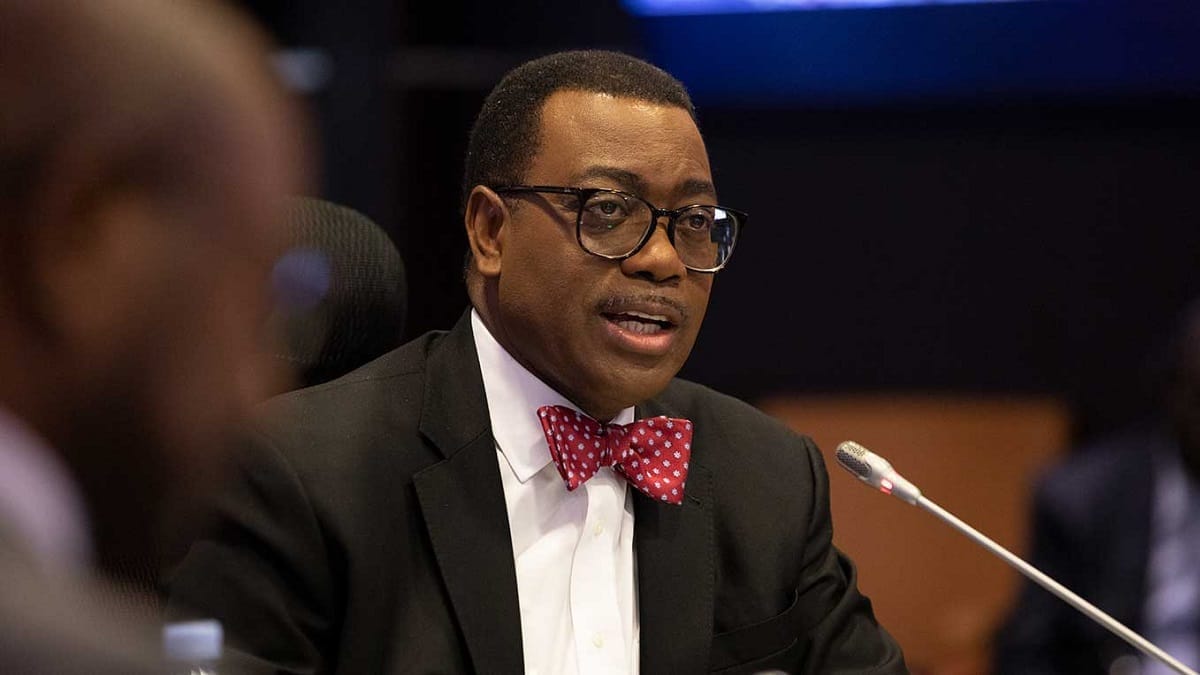
Investing in Africa is Profitable, AfDB President Tells Japanese Investors
The president of the African Development Bank Group, Dr. Akinwumi Adesina, has called for a significant increase in Japanese investment in Africa, saying the continent is the world’s best investment destination now and in the future.
Dr. Adesina is leading a Bank delegation on a five-day visit to Japan during which he will meet senior government officials, large Japanese companies, development partners and members of the African diplomatic corps in the country.
Delivering a lecture at the Japan-Africa Investment Ecosystem Co-Creation Forum in the capital, Tokyo, Adesina said Africa offers enormous investment opportunities and gave examples of Japanese companies that have been running profitable businesses on the continent for many years.
The forum was organized by Keizai Doyukai, a private, non-profit and nonpartisan organization that brings together nearly 1,400 top executives of some 1,000 corporations.
Adesina pointed out that Japan’s foreign direct investment in Africa declined from $10 billion in 2016 to just $4.7 billion in 2020 during Covid-19 but recovered to $6 billion in 2021. Africa accounts for only 0.003% of Japan’s $2 trillion global foreign direct investments.
In terms of trade, the volume of exports and imports between Africa and Japan remains lower than 2%.
Dr. Adesina said there was every reason to change the trend.
He mentioned the state-owned Japan Bank for International Cooperation (JBIC), which, together with TOTAL and other investors, including the African Development Bank, co-financed the $24 billion Liquified Natural Gas project in Mozambique—which will make it the third largest in the world. Japan will buy 30% of its production.
JBIC and Mizuho Bank, along with the African Development Bank and nine other financial institutions, invested $2.7 billion to build the Nacala corridor railway and port in Mozambique.
Dr. Adesina cited Japanese multinationals such as Toyota Tsusho, Mitsubishi Corporation, Hitachi and Komatsu, whose businesses make billions of dollars in profit every year.
“These companies will tell you investing in Africa pays!” said Adesina, “there is now a greater pulse and excitement for more Japanese investments in Africa.”
The Africa Development Bank chief said the successes of large Japanese companies operating in Africa are spurring a new generation of young Japanese to turn their eyes to venture capital and private equity funds to support small- and medium-sized enterprises.
He gave the example of a startup company, Kepple Africa Ventures, which has raised $43 million and is investing along with African private equity funds in 100 seed-stage enterprises in 11 African countries.
The Uncovered Fund, founded only in 2019, is another Japanese venture capital fund that has invested in 26 African startups.
Speaking during the Forum, the Vice Chairperson of the Africa Project Team at Keizai Doyukai, Ken Shibusawa, said a new company, &Capital Inc, was formed early this year to promote Japanese investments in Africa.
The Chairperson of the Japan-AU Parliamentary Friendship Association, Ichiro Aisawa, described Africa as a continent of hope with population power. The parliamentarian announced that with the Covid-19 pandemic under control, the association will embark on a grand tour of Africa to raise Japan’s presence.
While the number of Japanese companies in Africa increased from 520 in 2010 to 900 in 2020, Adesina called for more venture capital and private equity funds to tap into the continent’s huge potentials.
He thanked the Japanese government for recognizing Africa’s strategic importance and showing a strong political will to invest in Africa.
Japan’s Prime Minister Fumio Kishida announced during the TICAD 8 Summit in Tunis last year $30 billion for Africa, including support for startups in Africa, green growth, and training of 300,000 professionals from Africa.
The African Development Bank chief spelt out areas in Africa with enormous investment opportunities for Japanese investors.
Africa has the world’s highest demographic asset. Its population will rise to 2.4 billion by 2050. The continent has the largest number of young people in the world, with over 75% of its population aged less than 35 years.
“With appropriate skills, they will form the labour force for global industries as many countries face a rapidly ageing population,” said Adesina.
The recent establishment of the African Continental Free Trade Area makes Africa the largest free-trade zone in the world in terms of participating countries. Manufacturing opportunities alone would reach $1 trillion in 2025. And Africa’s consumer spending will reach $6.7 trillion by 2030.
In addition, Africa has the world’s largest renewable energy sources, including solar, wind, hydropower, and geothermal.
The continent also holds the key for the world as it transitions towards electric vehicles with its abundant deposits of minerals and metals such as platinum, lithium, cobalt, copper, and graphite.
“The manufacturing of lithium-ion batteries is most competitive in Africa. For example, setting up a lithium-ion battery precursor in the Democratic Republic of the Congo would be three times less expensive than in China or the US.”
Africa holds 65% of the remaining uncultivated arable land in the world. What Africa does with its agriculture will determine the future of food in the world. And the size of Africa’s food and agriculture market will rise to $1 trillion by 2030.
Other areas of enormous potential include the financial technology (fintech) sector; internet economy; healthcare; tourism; real estate, and automobile markets. For that reason, Adesina said the Japanese private sector and businesses should invest a lot more in the continent. “Your investment is safe in Africa.”
He referred to a survey conducted in 2020 by the African Private Equity and Venture Capital Association which indicated that about 45% of Limited Partners expected returns in Africa to outperform emerging and developed markets over the next 10 years. Also, 60% of the Limited Partners plan to increase allocations to Africa in the next three years.
Furthermore, in 2020, Moody Analytics looked at infrastructure debt default rates by region cumulatively over a ten-year period, comparing Africa with the rest of the world. It found that Africa had the second lowest cumulative default rate, after the Middle East, while default rates are much worse in Eastern Europe, Latin America, and Oceania.
Adesina reassured investors, “Africa is also not as risky to investments as many perceive,” and added, “Let’s ramp up Japanese private sector investments in Africa. Let’s do more together in Africa, faster and at scale.”
The African Development Bank’s delegation included Vice President for Power, Energy, Climate Change and Green Growth Dr. Kevin Kariuki, Vice President for Private Sector, Infrastructure and Industrialization Solomon Quaynor and Vice President for Agriculture, Social and Human Development Dr. Beth Dunford and the Executive Director of Argentina, Austria, Brazil, Japan and Saudi Arabia Takaaki Nomoto.
