

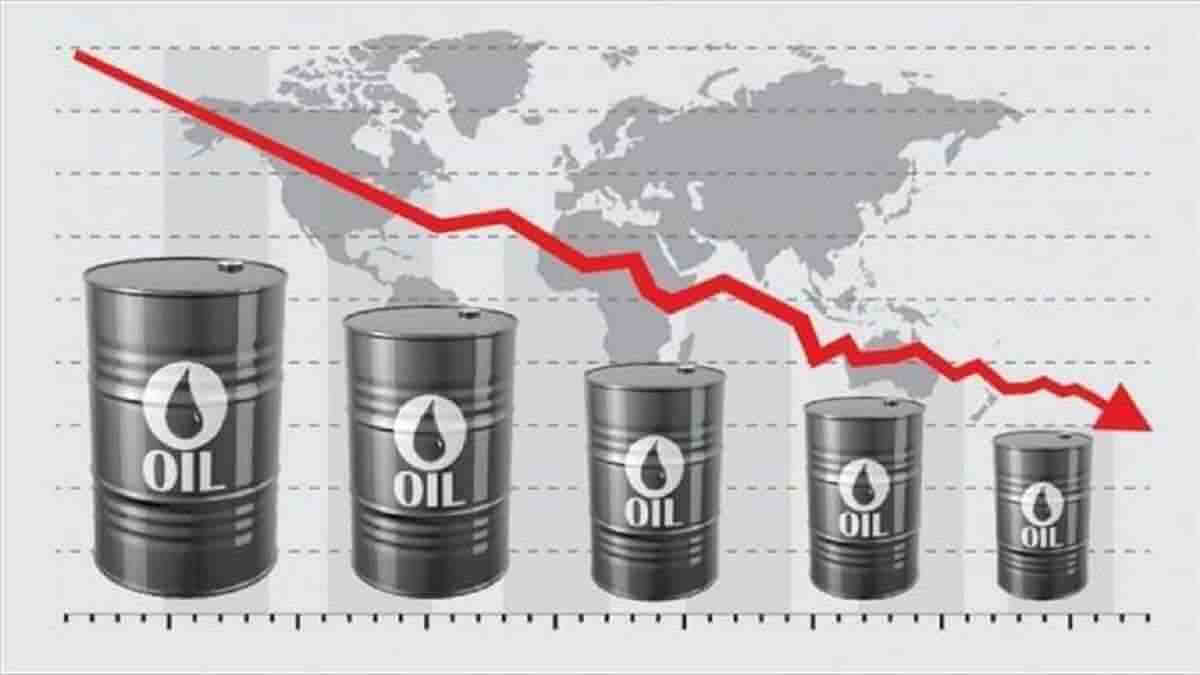
Oil Prices Drop amidst Fear of Rising COVID-19 Delta Variant
Oil prices were down Monday morning amid growing concerns over recent increases in COVID-19 infections, especially highly contagious delta variant, around the world, which may dampen global demand.
Investors also appear to be concerned about new variants of the virus that could lead countries to introduce new restrictions, likely to hamper economic growth.
Pressure started mounting on prices after Organisation of Petroleum Exporting Countries and allies (OPEC+) failed last week to reach a production increase quota agreement as the United Arab Emirates insisted on changing its production baseline upon which its quota was determined, saying the original baseline was unfair.
West Texas Intermediate oil futures for August delivery on the New York Mercantile Exchange was down $0.70, or 0.94%, at $73.86 in morning trading, while Brent crude for September delivery on the Intercontinental Exchange was off $0.56, or 0.74% at $75.02.
The highly infectious variant, first detected in India, has put the brakes on global economic recovery as nations grappled with fresh records of infections and renewed lockdown measures.
South Korea has placed its capital city of Seoul and nearby regions on the strictest level of restrictions, while Australia’s biggest city, Sydney, entered its third week of lockdown as new cases showed no signs of abating.
Uncertainty to future supply caused by the standoff between OPEC members Saudi Arabia and the United Arab Emirates could fuel price decline, analysts said.
Finance ministers of the world’s 20 largest economies warned on Saturday that an upsurge in new coronavirus variants and poor access to vaccines in developing countries are threatening the global economic recovery.
A final communique said the global economic outlook had improved since G20 talks in April, thanks to the rollout of vaccines and economic support packages, but acknowledged its fragility in the face of COVID-19 variants.
The rapid spread of the COVID-19 Delta variant and the re-emergence of strict measures in some regions raised concerns about economic activity while also fueling fears on the demand side.
In a related development, West African crude trading was sluggish on Monday as remaining cargoes and offers found no interest from potential buyers.
About 10 Angolan cargoes for loading in August were still available, a trader said, in line with Friday’s assessment. State oil company Sonangol is sold out of August cargoes. The September loading schedule is expected to be issued at the end of this week, or early next week.
Also, a cargo of Nigerian Qua Iboe for loading in late August was offered at the official selling price (OSP) plus 80 cents a barrel, a trader said. It wasn’t clear how this would translate into a dated Brent-related offer.
U.S. shale oil output expected to rise 42,000 bpd in August to 7.907 million bpd -EIA
Crude output from seven major shale formations is expected to rise by 42,000 bpd in August, to 7.907 million bpd, compared with a 28,000 bpd rise in July, according to Energy Information Administration’s (EIA) monthly drilling productivity report.
The forecast is led by growing production in the largest formation, the Permian Basin, where crude output is estimated to rise 53,000 bpd in the month, offsetting falling output expected from the Bakken formation of North Dakota.
Natural gas production from the major shale basins was expected to increase for the second month in a row, EIA said.
Total gas output will increase by less than 0.1 billion cubic feet per day (bcfd) to 85.5 bcfd in August. That compares with a monthly record high of 86.9 bcfd in December 2019.
Gas output in Appalachia, the biggest shale gas basin, was expected to decrease less than 0.1 bcfd to 34.4 bcfd in August. That compares with a monthly record of 35.6 bcfd in December 2020.
Gas output in the Haynesville in Texas, Louisiana and Arkansas was expected to increase over 0.1 bcfd to a record 13.5 bcfd in August, according to EIA data going back to 2007.
Read Also: EIA Makes Upward Adjustment to Oil Projection for 2021/2022
EIA said producers drilled 549 wells and completed 818 in the biggest shale basins in June. That left total drilled but uncompleted (DUC) wells down 269 to 6,252, their lowest since June 2018.
Oil Prices Drop amidst Fear of Rising COVID-19 Delta Variant
