

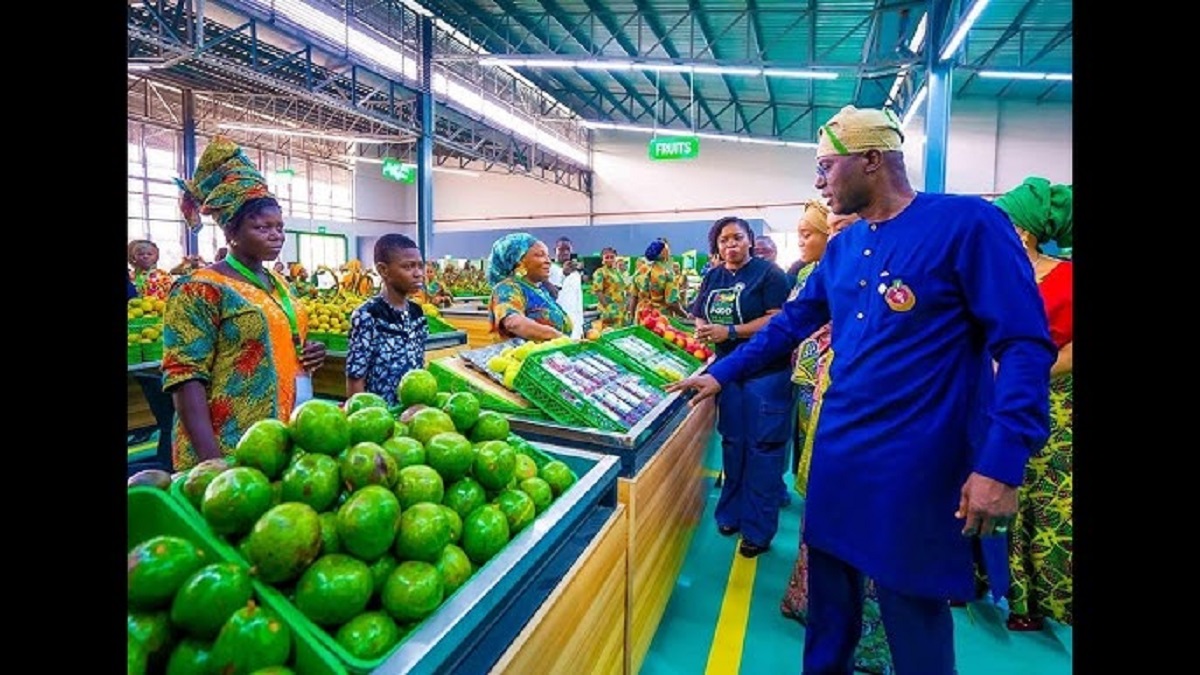
Lagos Inaugurates Agege Fresh Food Hub to Reduce Post-Harvest Losses
The Lagos State Government has inaugurated the Agege Fresh Food Hub to address post-harvest losses and strengthen food security.
The Mid-Level Agro-Produce Hub was commissioned on Wednesday at Pen Cinema, Agege, Lagos.
The facility is the third in the state, following the Fresh Food Hub, Mushin, commissioned in December 2023, and the Abijo hub commissioned earlier this year.
The hubs are designed to shorten supply chains, reduce unnecessary layers of intermediation, improve produce handling and make food distribution more efficient.
In his keynote address, Gov. Babajide Sanwo-Olu said the commissioning was essential to ensuring an effective food value chain in the state.
“Today marks another important milestone in our collective journey to build a food-secure, economically vibrant, and resilient Lagos.
“The commissioning of this Mid-Level Agro-Produce Hub in Agege is not simply the unveiling of another piece of infrastructure.
“It is the physical expression of a larger vision that places food security at the heart of our development agenda.
“It also recognises that the prosperity of Lagos is inseparable from the strength and efficiency of its food system,” Sanwo-Olu said.
He said when his administration began to rethink Lagos’ food system in 2021, it recognised that feeding the state required more than increasing food production.
“Lagos is Nigeria’s largest food market and one of Africa’s fastest-growing urban centres.
“With a population of over 25 million people, our demand for food is enormous and grows every day.
“Yet over 70 per cent of that food is produced outside our borders and travels long distances through fragmented supply chains.
“This exposes residents to high transportation costs, post-harvest losses, poor storage, supply disruptions and price volatility,” he said.
Sanwo-Olu said the state consequently decided to transform the entire food chain, from production through aggregation, logistics and processing to the markets.
He said this led to the Lagos State Food Systems Transformation Agenda, designed to help feed Lagos sustainably, affordably, efficiently and safely.
“This is why we created a network of Mid-Level Agro-Produce Hubs, beginning with the Fresh Food Hub, Mushin, commissioned in December 2023.
“This was followed by the Fresh Food Hub, Abijo, commissioned by His Excellency, President Bola Ahmed Tinubu, earlier this year,” he said.
According to him, the Mushin hub has recorded transactions valued at over ₦4 billion across 228 market days since its commissioning.
He added that the facility had registered more than 850 vendors and created over 7,000 direct and indirect jobs.
Sanwo-Olu said well-designed market infrastructure improved farmers’ incomes, reduced post-harvest losses, created jobs and strengthened local economies.
“Today, we proudly add Agege to that network. This Hub is strategically located to serve Agege and its neighbouring communities.
“It will also strengthen the wider food-distribution network across Lagos and bring modern food infrastructure closer to the people,” he said.
He said farmers within Lagos and across partner states could now produce against organised and guaranteed demand from the Lagos market.
According to him, the arrangement addresses two critical challenges confronting farmers: financing and market access.
He said it would reduce distress sales, improve farmers’ incomes and encourage greater investment in agricultural production.
Sanwo-Olu said the hubs were interconnected components of an integrated strategy to move food efficiently from farms to aggregation centres, markets and consumers.
He said the government was also progressing with similar projects at Opebi and Bombata, while locations had been identified in Ikorodu, Apapa, Festac and the Lekki axis.
“Our long-term objective is clear: to establish structured food hubs across every Local Government and Local Council Development Area of Lagos State.
“This is so that no community is left behind in the modern food-distribution network we are building,” he said.
Also speaking, the Lagos State Commissioner of Agriculture and Food Systems, Ms Abisola Olusanya, said the hub was established to improve food distribution across the state.
“Every project begins with a problem that needs solving, and for us the challenge was clear: how do we move food more efficiently into and across a city of this size?
“How do we reduce what we lose along the way and understand a food distribution system that has remained largely invisible to us?
“The answer was not a single market or facility, but an interconnected food distribution network built around a hub-and-spoke model,” Olusanya said.
She said the concept went beyond food distribution to addressing challenges associated with traditional food trading in a city of Lagos’ size.
Olusanya said the challenges included losses from poor handling and inadequate storage, traffic congestion and poor trading conditions for many traders.
She said the hubs would provide properly designed spaces for trading, improve waste management and organise loading and offloading activities.
According to her, the facilities will provide cleaner and more dignified trading environments while helping to organise the largely informal food economy.
“Mushin gave us our first opportunity to see the Middle-Level Hub operating in practice and subsequently demonstrated the versatility of having organised food infrastructure already in place.
“During the period of significant food inflation in 2024, it provided the platform from which we piloted the food subsidy intervention.
“That intervention eventually became the Ounje Eko Food Discount Market across 66 locations in Lagos,” she said.
Olusanya said Agege was another important node within the state’s food distribution network.
She said the infrastructure was supported by a 351-page operating framework detailing how the hub would function.
According to her, the hub will commence full operations in six weeks after completing operator onboarding and establishing the necessary systems.
She said produce would move into the hub through farmers, aggregators, processors, suppliers and bulk dealers.
Olusanya said commissioned agents, retailers and institutional buyers would then distribute the produce to consumers.
She added that cold and dry storage facilities would preserve produce where immediate sale was neither necessary nor desirable.
The commissioner said the operating framework covered operator selection, produce receiving, quality control, storage, inventory management, sanitation and waste management.
She said it would also provide better visibility of produce entering the facility, its source, volumes, storage and areas where losses occurred.
According to her, traders would retain control of commercial relationships, including prices, cash or credit terms and other arrangements.
She said the government and hub management would provide infrastructure, operating rules and oversight to ensure efficient operations.
“The benefit of the hub is therefore not concentrated at one end of the value chain.
“It comes from creating a platform in which each participant is able to do what they already do, but within a system that allows the entire chain to function better,” she said.
Olusanya said the choice of Agege was deliberate because of its entrepreneurial energy and longstanding role as a commercial centre.
She said the Pen Cinema location was appropriate for a facility built around the movement of food and trade.
According to her, the hub occupies approximately 7,000 square metres and has a 4,000-square-metre trading floor.
She said the trading floor could accommodate between 350 and 400 vendors.
The facility also has about 1,200 square metres of dry storage with a capacity of approximately 800 metric tonnes.
Olusanya said the hub also had about 300 metric tonnes of cold storage capacity for preserving fresh produce.
She said the facility included an expanded seafood section, reflecting the importance of seafood to Lagos as a coastal state.
The hub also has parking space for between 80 and 90 vehicles and 10 electric vehicle charging points.
Olusanya said the facility was projected to facilitate well in excess of ₦5 billion in food transactions annually.
She said the projection was based on the hub’s trading capacity, number of operators and volume of food it was designed to handle.
“The hub will commence full operations in six weeks, allowing us to complete the onboarding of operators.
“We will also put the operating, logistics and governance systems required for day-to-day trading fully in place,” Olusanya said. #Lagos Inaugurates Agege Fresh Food Hub to Reduce Post-Harvest Losses# Lagos Needs Bigger Budget to Meet Infrastructure Needs — Hamzat
