

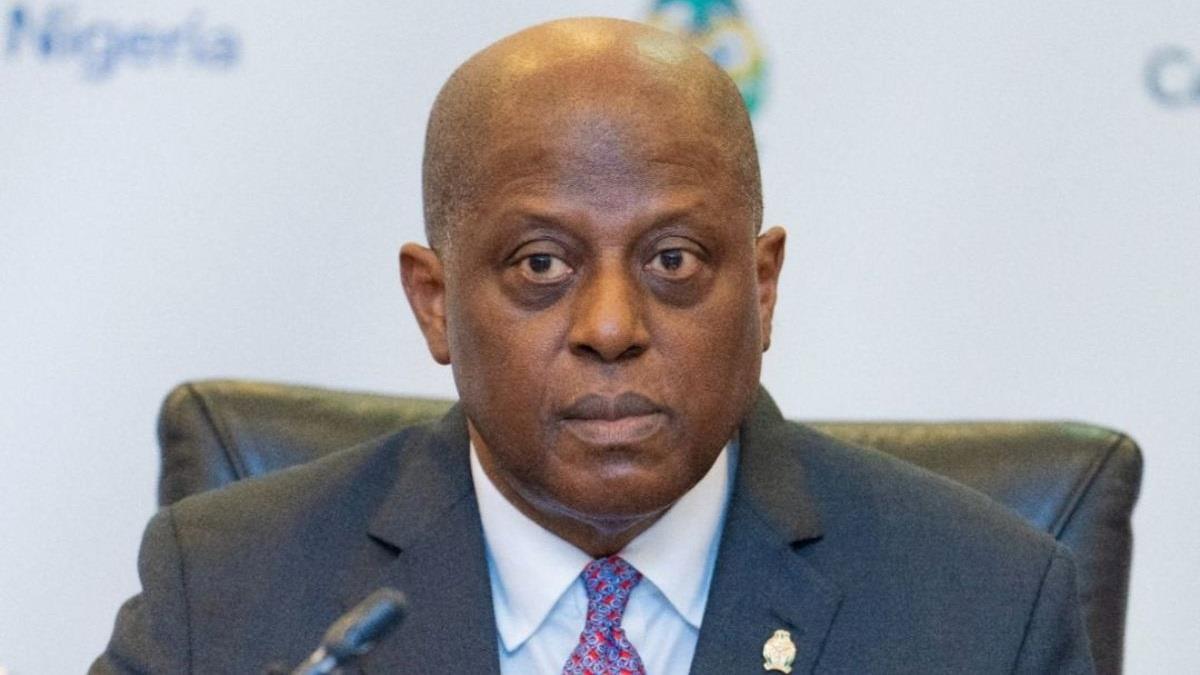
Cross-Border Payments Backbone of Monetary, Financial Systems – Cardoso
Mr Yemi Cardoso, the Governor of the Central Bank of Nigeria (CBN), says cross-border payments are becoming the backbone of the international monetary and financial system globally.
Cardoso, in his plenary speech, said this in Abuja on Thursday at the G 24 Technical Group Meetings (TGM) themed “Mobilising Finance for Sustainable, Inclusive, and Job rich Transformation’’.
The title of his speech was, “Digital Cross-Border Payments, Global Finance, and Economic Transformation – Opportunities and Risks”
Cardoso said, “for G 24 economies, inefficiencies in these systems translate directly into higher remittance costs, costly FX transactions, fragmented settlement processes, and barriers to MSME participation in global trade.”
He said that improving cross-border payments was, therefore, not simply a technical reform, but a macroeconomic and development priority.
“The channels through which capital, remittances and trade flows move now form a critical part of global financial stability architecture.
“Today, cross border payments remain too slow, too costly, and too fragmented, especially for developing economies.
“With global remittance corridors costing over 6.0 per cent, settlement lags of several days, and compliance burdens that exclude MSMEs, millions remain disconnected from global opportunity,” he said.
The CBN governor said that digital innovation now presented a historic opportunity to correct these frictions.
He said that modern payment infrastructure, instant payment systems, interoperable digital platforms, distributed ledger technology, and robust digital identity frameworks could reduce transaction costs for remittances and trade.
He said that such assets could also shorten settlement times, improve transparency, compliance, and auditability and expand access for households and MSMEs traditionally excluded from the formal financial system.
”Interoperable digital systems also strengthen the transmission of monetary policy, expand financial inclusion, and reduce informality, if designed with resilience and strong governance.
“These opportunities are not theoretical. They are happening around the world,” he said.
Cardoso said India’s Unified Payments Interface (UPI) now linked with Singapore and the UAE, had slashed remittance costs and enabled ubiquitous real-time settlement.
He said that Brazil’s PIX, adopted by over 70 per cent of adults within two years, was being integrated into cross-border pilots across Latin America.
“These examples demonstrate what is achievable for G 24 members, including lower costs, better liquidity, stronger SMEs, job creation, and deeper regional integration,” he said.
According to him, Nigeria’s experience demonstrates that this potential can be realised through deliberate and sustained policy action.
“At the CBN, we have systematically modernised our regulatory and supervisory frameworks to keep pace with the rapidly evolving digital financial landscape.
“We strengthened operational oversight of switching and payment infrastructure providers, enhanced agent banking regulations to better address Anti-Money Laundering/Anti-Money Laundering Countering the Financing of Terrorism (AML/CFT) risks.
“We also significantly improved interoperability across payment channels to support efficiency and scale, ” he said.
Cardoso said that building on these reforms, CBN was concluding work on the new Payment System Vision 2028, developed in close collaboration with industry stakeholders.
“It was built around five strategic priorities aimed at boosting innovation, strengthening system resilience, and advancing financial inclusion, ” he said.
He added that a central part of the agenda was improving the cross-border payments environment, where Nigeria had made concrete, measurable progress.
Also speaking, Mr Wale Edun, the Minister of Finance and Coordinating Minister of the Economy, said that there was a need for unity among countries of the Global South to check the rising fragility in global growth.
Edun said that the current global economic environment was marked by profound uncertainties, systemic vulnerabilities and a contest between fragmentation and integration, which also hampered trade and debt sustainability.
The minister said that the recurring theme of fragility, whether in growth, trade flows, debt sustainability or institutional capacity reflected the precarious state of the global economy.
He said that the TGM was not merely a routine technical engagement.
According to him, it is also an opportunity to reshape development trajectories for countries of the Global South at a time when global risks were converging faster than institutions could respond.
He said that the 2026 Global Risk Report identified economic confrontation in the form of tariffs, sanctions, investment restrictions and strategic decoupling as the most likely trigger of global crises.
“Deepening fragmentation can reduce global output by up to two percentage points and shrink global trade by more than two per cent, with developing and emerging markets bearing the brunt.
“Africa, despite accounting for 17 per cent of the world’s population, contributes only about three per cent of global trade and roughly 2.5 per cent of global output.
”Further fragmentation can only worsen this imbalance,” he said.
Earlier, Dr Iyabo Masha, the Director and Head of Secretariat of the Intergovernmental Group of the G-24, said that the global economy was witnessing measured resilience but constrained ambition.
Masha said that Emerging Markets and Developing Economies (EMDEs) faced tightening policy space amid rising uncertainty.
According to her, while supply-side disruptions have eased and inflation has moderated in many economies, resilience should not be mistaken for robustness.
“We meet at a moment of measured resilience but constrained ambition in the global economy.
“For many EMDEs, the challenge is no longer simply to recover, but to restore development trajectories, protect macroeconomic stability, and finance transformation in a world of higher volatility,” she said.
She identified five broad themes shaping the current outlook.
She listed the themes to include a stable but divergent global economy, tightening policy space for EMDEs, emerging near-term risks, the need for medium-term transformation policies, and urgent reforms of the Bretton Woods institutions.
On the global outlook, Masha said that although disinflation had progressed in several advanced economies, inflation dynamics remained vulnerable to supply shocks, climate events and geopolitical tensions.
She said that while global financial conditions had eased compared to periods of intense tightening, the cost of capital remained elevated for many developing countries, with spreads and debt-service burdens still above pre-pandemic levels. CBN Allots OMO Bills Expiring in 8 Days to Investors
