

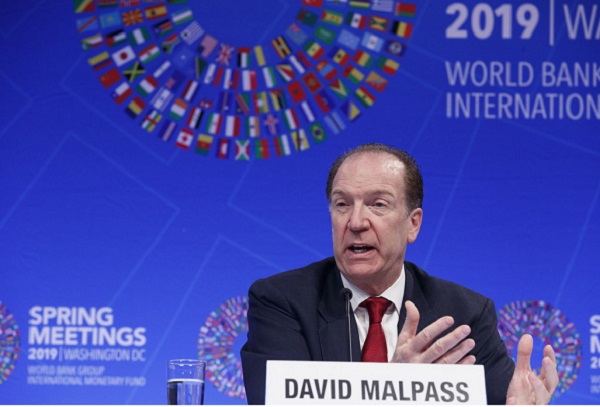
We can end extreme poverty, says World Bank David Malpass
FIGHTING POVERTY, LIFTING THE POOR: In the fall of 1973, the World Bank’s fifth president, Robert McNamara, thrust into the international consciousness a word that does not appear in the Bank’s articles of agreement: poverty.
In his speech to shareholders at the Bank’s Annual Meetings in Nairobi, Kenya, McNamara argued that the Bank’s mission should be to alleviate “absolute poverty,” which he described as “a condition of life so degrading as to insult human dignity—and yet, a condition of life so common as to be the lot of some 40 percent of the peoples in developing countries.”
Read Also: Julius Berger: FX Losses, Inactivity Deflate Earnings Performance
He asked the shareholders, “Are not we who tolerate such poverty, when it is within our power to reduce the number afflicted by it, failing to fulfill the fundamental obligations accepted by civilized men since the beginning of time?”
Partnering with Treasurer Eugene Rotberg, McNamara guided a dramatic expansion in the World Bank’s lending, financed by borrowing from new capital markets throughout the world and innovative financial techniques.
Rotberg’s expertise in the bond market helped double the overall lending program of the Bank in just five years, from 1968 to 1973.
McNamara made the case that more of that capital should go to help the poorest and most vulnerable by focusing on rural development, increasing access to public services, and reorienting development policies to fight inequality.
“In a way that was never true in the past, we now have the power to create a decent life for all men and women,” he told the shareholders in Nairobi.
“The extremes of privilege and deprivation are simply no longer acceptable. It is development’s task to deal with them.”
When McNamara retired from the World Bank Group in 1981, the global poverty rate was 42 percent. His challenge, and the Bank Group’s new mission, would endure for decades.
During two terms as president of the World Bank Group, from 1995 to 2005, Jim Wolfensohn emphasized the urgency of the task.
“If we want stability on our planet, we must fight to end poverty,” he said in 2004.
It is still the challenge of our time. But Wolfensohn knew that the fight to end poverty was impossible without tackling what he called “the cancer of corruption.”
He argued that the poor suffer the most from corruption—in funds diverted from life-saving medicine, safe roads, and education that gives people a chance for a brighter future.
He also pointed to the reality that a corrupt environment is much less likely to attract development investments, leaving the poor to suffer twice over.
Those fights continue to this day.
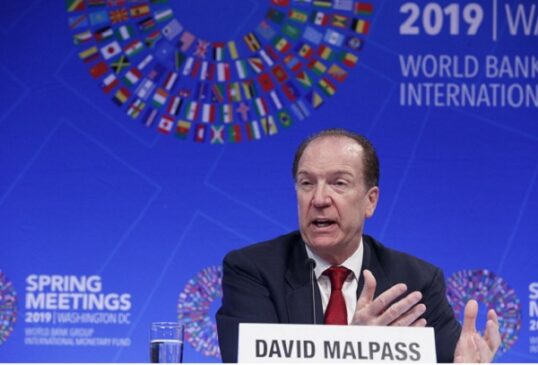
Emerging from a period of strong poverty alleviation but facing urgent global challenges, the World Bank Group is strong financially and well positioned with the right tools and resources, and a talented and professional staff.
The World Bank Group today draws a more diverse pool of talent than ever before. For example, only 2 of the more than 700 delegates at Bretton Woods were women.
Today, women make up nearly 53 percent of World Bank Group staff, 42 percent of its managers, and nearly 49 percent of the senior management team.
In the years to come, we will continue to focus on achieving breakthroughs in developing countries that will raise median incomes; create jobs; fully incorporate women and young people into economies; and support a stronger, more stable economy for everyone.
Those goals—and the necessary cooperation to achieve them—are what the Bretton Woods delegates had in mind from the very beginning.
They created strong institutions in which the nations of the world could work together to address the most urgent challenges and improve the lives of people all over the world.
On July 22, 1944, when negotiations were complete, Secretary Morgenthau closed the Bretton Woods Conference.
“The Conference at Bretton Woods has erected a signpost pointing down a highway, broad enough for all men to walk in step and side-by-side,” he told the delegates.
“If they will set out together, there is nothing on earth that need stop them.”
Today, the pace of innovation is accelerating, and millions continue to escape poverty. But the world is also more fragile than in recent decades, as more of the world’s poor live in areas suffering from conflict, violence, and the effects of climate change.
Leaders need to focus on liberty and safety, as well as on opportunity and prosperity. Creating equality of opportunity is the key challenge of our time, and that mission is more urgent than ever.
If we set out together, men and women, and use our powerful tools for the poorest and most vulnerable, we can end extreme poverty and advance development and shared prosperity around the world.
Walking with a common purpose, in step and side-by-side, nothing can stop us.
We can end extreme poverty, says World Bank David Malpass
David Malpass, President, World Bank Group
