
Close Menu
MarketForces AfricaMarketForces Africa
    What's Hot

    Nigeria’s Local Petrol Production Hits 48m Litres Per Day -FG

    June 23, 2026

    South African Rand Trades Sideways Ahead of Bond Auction

    June 23, 2026

    Wall Street Slips on Tech Stocks Selloffs, FTSE 100 Gains

    June 23, 2026
    Facebook X (Twitter) Instagram
    Trending
    • Nigeria’s Local Petrol Production Hits 48m Litres Per Day -FG
    • South African Rand Trades Sideways Ahead of Bond Auction
    • Wall Street Slips on Tech Stocks Selloffs, FTSE 100 Gains
    • Oil Prices Fall as Iranian Crude Exports Boost Supply
    • XRP Slides, Extends 7-Day Loss in Absence of Buyers’ Conviction
    • GRAM Rises 6% as Bybit Listing Boosts Optimism, Access
    • DeXe Gains 60% as Traders Short on Bybit, Long on Binance
    • DMO Hikes Rates on Bonds to Meet N1.2trn Borrowing Target
    • Home
    • About Us
    Facebook X (Twitter) Instagram LinkedIn WhatsApp TikTok Telegram
    MarketForces AfricaMarketForces Africa
    Subscribe
    Tuesday, June 23
    • Home
    • News
    • Analysis
    • Economy
    • Mobile Banking
    • Entrepreneurship
    MarketForces AfricaMarketForces Africa
    MarketForces Africa » Inside Africa » South African Banks’ Sovereign Exposure Grows Amidst Weak Lending

    South African Banks’ Sovereign Exposure Grows Amidst Weak Lending

    Anthony PersuaderBy Anthony PersuaderSeptember 19, 2025Updated:September 19, 2025 Inside Africa No Comments3 Mins Read
    South African Banks’ Sovereign Exposure Grows Amidst Weak Lending
    Source: Fitch Ratings
    Share
    Facebook Twitter LinkedIn Pinterest Email Tumblr Reddit Telegram WhatsApp Copy Link

    South African Banks’ Sovereign Exposure Grows Amidst Weak Lending

    South African banks are facing ever-higher sovereign exposure, strengthening the linkage between their credit profiles and that of the sovereign and reinforcing the longstanding sovereign constraint on the largest banks’ ratings, Fitch Ratings says.

    Exposure has been increasing for over a decade, driven by banks’ subdued appetite for private sector risks in a weak macroeconomic environment, greater banking sector liquidity and government debt issuance, and capital optimisation strategies, according to Fitch.

    The sector’s sovereign exposure is dominated by holdings of rand-denominated central government securities. It expanded to ZAR1,586 billion at end-1H25 from ZAR517 billion at end-2015.

    Fitch said higher sovereign exposure relative to capital has increased the sensitivity of banks’ solvency to losses that could be imposed on creditors in the event of a sovereign default.

    This reinforces the longstanding constraint on the ‘BB-’ Long-Term Issuer Default Ratings (IDRs) of the five largest banks by South Africa’s ‘BB-’/Stable Long-Term IDRs.

    South Africa’s persistently weak macroeconomic environment has weighed on private sector lending and been a key driver of rising sovereign exposure.

    Real GDP growth averaged only 0.7% over 2015–2024, reflecting deeply entrenched structural problems, including high levels of inequality, poverty and unemployment.

    More recently, difficulties for state-owned enterprises have aggravated the situation, disrupting energy supply and weakening the performance of the logistics sector.

    Banks’ credit profiles have been resilient, with the sector impaired loans ratio at 5.2%-5.5% during 2020-1H25 from 3.1% in 2015.

    The banks have demonstrated heightened risk aversion, with sovereign exposure growth typically outpacing loan growth, which has averaged just 5.2% annually in nominal terms over the past decade.

    Non-resident investor appetite for South African government bonds has decreased since the 2017 sovereign downgrade to sub-investment grade. Non-residents held about 40% of domestic government securities in 2017 but only about 25% in mid 2025.

    This has contributed to increasing participation by domestic banks in government securities issuance, particularly as the outstanding stock of government bonds more than doubled from about ZAR1,250 billion at end 2017 to about ZAR3,000 billion at end-1H25.

    Banking sector liquidity conditions and the South Africa Reserve Bank’s monetary policy have encouraged the rising sovereign exposure.

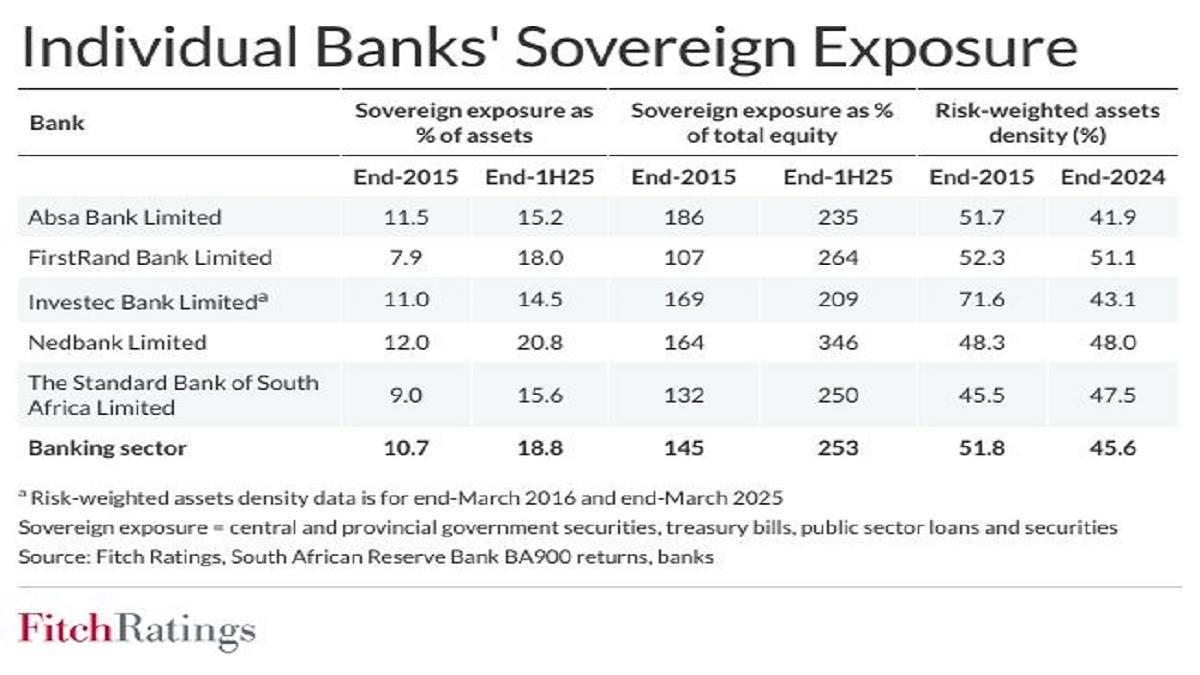
    The new monetary policy implementation framework, introduced in 2022, and further initiatives in 2023-2024 have resulted in a larger liquidity surplus, which banks have partly channelled into government securities. The banks’ sovereign exposure increased to 18.8% of sector assets at end-1H25 from 10.7% at end-2015.

    For the largest banks, exposure increased even more significantly as a percentage of total equity as many pursued capital optimisation strategies, Fitch said. 

    Analysts stated that this is reflected in the sector’s total equity/assets ratio declining to 7.4% at end-1H25 from 8.9% at end-2017.

    The increased sovereign exposure contributed to a fall in the sector’s risk-weighted asset density to 45.6% at end-2024 from 51.8% at end-2015 as rand-denominated government securities have a zero risk-weight. Ecobank Gets $200m Sustainability-Linked Loan from European DFIs

    Share. Facebook Twitter Pinterest LinkedIn Tumblr Email
    Anthony Persuader
    • Website

    Financial Journalist with global coverage.

    Keep Reading

    Nigeria’s Local Petrol Production Hits 48m Litres Per Day -FG

    South African Rand Trades Sideways Ahead of Bond Auction

    Wall Street Slips on Tech Stocks Selloffs, FTSE 100 Gains

    Oil Prices Fall as Iranian Crude Exports Boost Supply

    XRP Slides, Extends 7-Day Loss in Absence of Buyers’ Conviction

    GRAM Rises 6% as Bybit Listing Boosts Optimism, Access

    Add A Comment

    Comments are closed.

    Editors Picks

    Nigeria’s Local Petrol Production Hits 48m Litres Per Day -FG

    June 23, 2026

    South African Rand Trades Sideways Ahead of Bond Auction

    June 23, 2026

    Wall Street Slips on Tech Stocks Selloffs, FTSE 100 Gains

    June 23, 2026

    Oil Prices Fall as Iranian Crude Exports Boost Supply

    June 23, 2026

    XRP Slides, Extends 7-Day Loss in Absence of Buyers’ Conviction

    June 23, 2026
    Latest Posts

    Nigeria’s Local Petrol Production Hits 48m Litres Per Day -FG

    June 23, 2026

    South African Rand Trades Sideways Ahead of Bond Auction

    June 23, 2026

    Wall Street Slips on Tech Stocks Selloffs, FTSE 100 Gains

    June 23, 2026

    Oil Prices Fall as Iranian Crude Exports Boost Supply

    June 23, 2026

    XRP Slides, Extends 7-Day Loss in Absence of Buyers’ Conviction

    June 23, 2026

    Subscribe to News

    Get the latest sports news from Dmarketforces Africa about finance, business and tech.

    Advertisement
    Facebook X (Twitter) Pinterest Vimeo WhatsApp TikTok Instagram

    News

    • World
    • Politics
    • Economy
    • Business
    • Opinions
    • Fintech
    • Science & Technology

    Company

    • About us
    • Advertising
    • Classified Ads
    • Contact Info
    • Editorial Policy

    Services

    • Subscriptions
    • Research
    • Due Diligence
    • Newsletters
    • Sponsored News
    • Work With Us

    Subscribe to Updates

    Subscribe to updates from MarketForces Africa, an independent financial news service provider.

    © 2026 MarketForces Africa. All rights reserved.
    • Privacy Policy
    • Terms
    • Accessibility

    Type above and press Enter to search. Press Esc to cancel.