


Nigeria Records Third Consecutive Quarter of Negative Trade Balance
Nigeria has recorded a third consecutive of negative trade balance with the second quarter deficit position at N1.80 trillion.
According to a recent trade report by the National Bureau of Statistics, the value of Nigeria’s merchandise trade dropped to N6.242 trillion in the second quarter (Q2) of 2020.
NBS said decline indicates a sharp drop of 27.30% when compared to Q1, 2020 and 27.46% compared to Q2, 2019.
According to NBS data, the value of total trade year to date amounted to N14.829 trillion, indicating a drop of 11.96% compared to half year 2019.
The import component was valued at N4,022.9 billion representing a drop of 10.69% in Q2, 2020 against the level recorded in Q1:2020 but an increase of 0.39% year-on-year.
Meanwhile, the export component accounted for N2,219.5 billion of the total trade, indicating a decline of 45.64% against the value recorded in Q1, 2020 and 51.73% compared to Q2, 2019.
Read Also: GUINNESS Nigeria: Vetiva, Afrinvest give opposing rating, same day
Consequently, the trade balance recorded a deficit of N1,803.3 billion, marking the third consecutive quarter of negative trade balance.
This compares with trade in goods deficit of N421.3 billion recorded in Q1, 2020 and N579.06 billion recorded in Q4 2019.
NBS revealed that crude oil remains Nigeria’s dominant export, accounted for N2,944.6 billion representing 72.12% of total exports in Q1:2020.
However, the value of crude oil export was 18.86% less than the value recorded in Q4, 2019 and 12.80% lower than the value recorded in the corresponding quarter of 2019.
Non crude oil exports was valued at N1,138.3 billion representing 27.9% of total exports during the period under review.
Meanwhile, the value of total imports amounted to N4,022.9 billion in Q2, 2020.
The figure represents a drop of 10.69% against the level recorded in Q1:2020 but an increase of just 0.39% year-on-year.
The year to date import value amounted to N8,527 billion, or 10.58% over half year 2019.
NBS stated that the fall in value of import in Q2:2020 can be attributed to the decrease in the value of mineral fuels (N1031.9billion or 82.35%), Machinery and Transport equipment (N147.2billion or 8.43%) and Miscellaneous manufactured articles (N157.5 billion or 47.94%) against their respective values in Quarter 1, 2020.
It explained that the structure of imports under this category showed that Machinery and transport equipment accounted for the largest share of imports, at N1,598.8 billion or 39.7% of total imports.
This was followed by Chemicals and related products, valued at N776.3billion or 19.30% and Food and Live Animals worth N648.6 billion or 16.1% among others.
During the quarter, Nigeria imported goods mainly from Asia, which was valued at N2,122.6 billion or 52.8%.
Other imports originated from Europe, valued at N1,070.4 billion or 26.6% while imports from America and Africa amounted to N605.2billion or 15% and N174billion or 4.3% respectively.
Import from Oceania stood at N50.6billion or 1.3% while goods valued at N31.1billion originated from ECOWAS.
Nigeria’s imports, by country of origin, shows goods were imported mainly from China (N1,263.6 billion or 31.41%), United States (N428.9 billion or 10.66%), India (N322.3 billion or 8.01), and the Netherlands (N202.9billion or 5.04% respectively.
The value of exports in Q2, 2020 stood at N2,219.5 billion, a decrease of 45.64% compared to Q1, 2020 and 51.73% compared to Q2, 2019.
The year to date export amounted to N6,302.4 billion, representing a 31% decline compared to 2019.
Exports by section revealed that mineral products accounted for the largest portion of exports, amounting to N1,872.4 billion or 84.35%, mainly due to the crude oil component.
This section was followed by Vehicles aircraft and parts (N221.2billion or 9.96%) and others.
Analysis of export by Region revealed that Nigeria exported most products to Europe (N976.5billion or 44%), followed by Asia (N734.1billion or 33.08%), Africa (N401.4billion or 18.1%), America (N105.8billion or 4.8%) and Oceania (N1.7billion or 0.08%).
Within Africa, goods worth N149.3billion were exported to ECOWAS member states.
NBS also revealed that all regions recorded declines in the value of exported goods during the quarter, although China and Japan each recorded increased export activity.
Exports by Country of destination showed that Nigeria exported goods to Spain valued at (N310.8billion or 14%), Netherlands (N243.7billion or 10.98%), China (N220.4billion or 9.9%),India (N195.6billion or 8.8%) and South Africa (N172.2 or 7.7%)
Meanwhile, NBS data shows that the value of total imports dropped by 10.69% in Q2, 2020 against the level recorded in Q1:2020 but increased by 0.39% year-on-year.
Energy goods imports increased tremendously by 591.47% in Q2, 2020 compared to Q1, 2020 and 129.78% year-on-year.
Also, Solid minerals imports increased in value by 35.51% in Q2: 2020 compared to Q1, 2020 but decreased 0.47% compared to Q2:2019.
Imported Agricultural goods rose in value by 59.01% in Q2:2020 compared to Q1, 2020 and 66.28% compared to the corresponding quarter in 2019.
Other oil products imports decreased by 82.32% in Q2:2020 compared to Q1, 2020 and 75.66% when compared to Q2, 2019.
Then, raw material imports increased by 85.69% in Q2:2020 compared to Q1, 2020 and 64.69% year –on-year.
Just as manufactured goods imports increased in value by 4.69% in Q2:2020 compared to Q1, 2020 and 12.72% year-on-year.
Data shows that total exports was 45.64% lower in Q2:2020 than Q1:2020 and 51.73% lower than Q2, 2019.
Of this, agricultural goods export dropped 38.2% in Q2:2020 compared to Q1, 2020 but rose 6.3% year-on-year.
Raw material goods export recorded a decrease of 56.2% in Q2: 2020 compared to Q1, 2020 and 52.4% compared with the same quarter in 2019.
Solid minerals exports registered a decrease of 2.3% in Q2: 2020 compared to Q1:2020 and 79.4% compared to Q2,2019.
Other oil products decreased by 40.7% in Q2:2020 compared to Q1, 2020 and 28% compared to Q2,2019.
Crude oil exports decreased in value by 47.2% in Q2:2020 compared to Q1, 2020 and 60.5% year-on-year while energy goods decreased by 13.7% in Q2, 2020 compared to Q1, 2020 and 53.8%.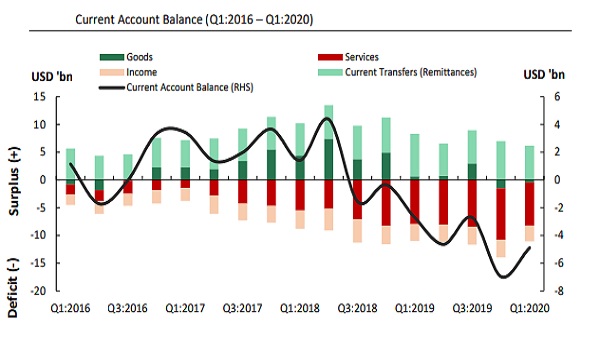
Then, manufactured goods export decreased in value by 42.8% in Q2:2020 against the level recorded in Q1:2020 but increased 139.6% compared with the corresponding quarter in 2019
Nigeria Records Third Consecutive Quarter of Negative Trade Balance
