

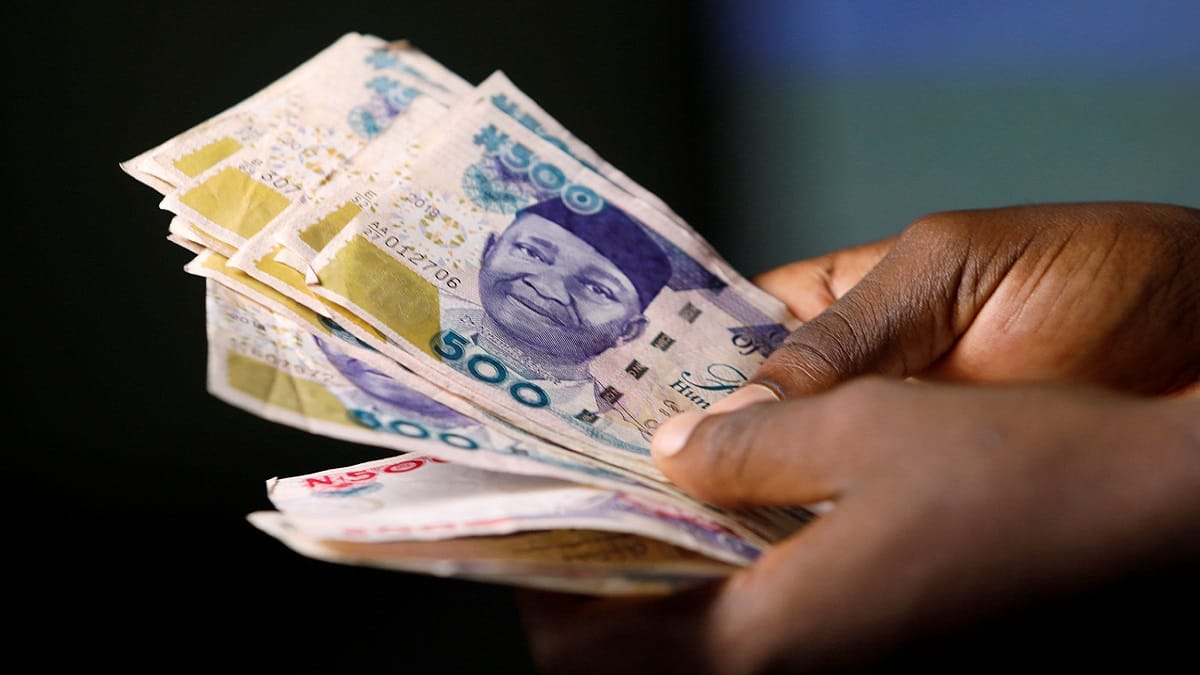
Naira to Test New Low as NDF Signals Devaluation
Based on the non-deliverable forward (NDF) rate movement, the Institute of International Finance (IIF) says in its latest report that the Nigerian local currency could rise to N470 to a dollar in 2022.
According to data from the World Bank, Nigeria sees the highest devaluation of its local currency between 2015 when it was N192.44 and 2017 when it printed at N305.79 to a dollar at the official window.
By 2019, the exchange rate adjusted to N306.94 and peaked at N358.811, according to the foreign exchange rate movement on the multilateral lender data portal. On its website, CBN investors and exporters FX rate stand at N411.74.
In its latest mission to Nigeria, the International Monetary Fund had also asked the apex bank to adopt a unified market-clearing foreign exchange rate to attract foreign investments into the country.
Though remittances from Nigerians in diaspora improve, according to the latest report from the World Bank group, the total foreign inflow has remained at the pre-pandemic period.
In the Investors and Exporters foreign exchange window, the market had seen inflows from foreign investors at around 53%, according to Cordros Capital, a firm that insists that for Naira to trade better, cold money from offshore would really be needed in the economy.
Like other investment firms, consensus analysts’ position about naira valuation is that the local currency is relatively overvalued. CBN is delaying the inevitable, an investment expert, Kingsley Aigbe CFA told MarketForces Africa in a chat.
Cordros said it expects Naira to be devalued despite a relatively healthy external reserves position, powered by foreign currency borrowings, IMF special drawing rights and receipt from oil exports.
But a devaluation would have damaging effects on Nigerian citizens that are already facing pressures from steep headline inflation and previous devaluation of the local currency.
‘The last thing Nigeria government would do now is to officially devalue Naira’, an economist who prefers not to be mentioned told MarketForces Africa.
He said the government that engages in social intervention would not wish to go that way, adding the IMF and any investment firms – local and global – that think devaluation is the next thing needed is of course asking for near impossible.
Lack of market-clearing FX quote has been hindering foreign investors participation in the Nigerian economy, IMF indicates in its latest staff mission to Nigeria.
Naira has been officially devalued more times in the last six years due to shortage amidst steep demand for import bills payment. In 2015, the Naira exchange rate for an official transaction was quoted by the CBN as N197.
Now, at the official window, more than N410 is demanded to obtain a United States dollar as dollar inflow from exports, foreign investments slowdown.
In a macro note on Nigeria, IIF hinted about an expectation of a devaluation of the local currency, saying Nigeria’s exchange rate regime and FX shortages remain among the key issues. Nigeria’s local currency has come under renewed pressure in the parallel market in the third quarter of 2021, the Institute noted in its macro note obtained by MarketForces Africa.
“We expect the CBN to undertake another steep devaluation in the coming months. NDFs indicate that the currency could rise to N470/$ by the end of next year”, the Institute stated.
The Nigerian local currency, naira, witnessed a moderate gain in the official foreign exchange window as Central Bank used up some $125 million this week from the external reserves.
“We expect the CBN to undertake another step devaluation in the coming months. NDFs indicate that the currency could rise to NGN470/$ by the end of next year”, the Institute stated.
Naira closed at N414.73 to a dollar at the Investors and Exporters foreign exchange window, gaining 0.29% % in the week on healthy dollar supply but weakened 0.01% in the parallel market to N565.55.
Following CBN efforts to support the naira at the official channels, total foreign currency reserves available to the country for external transactions dropped off, albeit mildly, amidst fresh pressure from the Covid-19 Omicron variant in the global oil market.
After shedding $124.86 million, external reserves now settle at $41.15 billion while the local currency depreciated 0.2% week on week to N565.00 to a dollar at the parallel market.
This week, the volume of dollars transacted at the Nigerian Autonomous Foreign Exchange Fixing (NAFEX) market slowdown, data from the FMDQ Exchange platform shows.
Total turnover at Investors and Exporters FX window declined by 22.7% from the beginning of the week to $772.53 million, according to Cordros Capital analysts note with trades consummated within the N404.00 – 457.86 per dollar band.
Meanwhile, the exchange rate closed flat at N430.00 a dollar at the Interbank Foreign Exchange market amid its weekly injections of $210 million, according to Cowry Asset analysts’ note.
Of the sum injected into the market, $100 million was allocated to Wholesale Secondary Market Intervention Sales (SMIS), $55 million was allocated to Small and Medium Scale Enterprises and $55 million was sold for Invisibles.
Naira for dollar exchange rate further rose for most of the foreign exchange forward contract. Hence, 1 month, 3 months, 6 months and 12 months contracts increased by 0.03%, 0.03%, 0.03% and 0.03% to close at N416.07, N421.33, N430.47 and N448.13 respectively.
However, a 2-month contract appreciated by 0.01% to close at N418.46. In the new week, analysts at Cowry Assets expect Naira to strengthen slightly against the dollar amid relatively high crude oil prices and external reserves.
The CBN has enough supply to support the FX market over the short term, given inflows from the recently issued Eurobond and the IMF’s SDR, according to Cordros Capital.
However, analysts maintain that foreign inflows are paramount for sustained FX liquidity over the medium term. In line with analysts’ expectations, it said accretion to the reserves will be weak given that crude oil production levels remain quite low.
According to the November edition of the OPEC Monthly Oil Market Report (MOMR), Nigeria’s average crude oil production (excluding condensates) settled at 1.35 million barrels per day in October from 1.40 mbpd in September, 19.6% below the 1.68mbpd that the latest agreement permits.
As a result, average crude oil production declined by 13.5% year on year in 10-month of 2021 to 1.39 mbpd compare to 1.61 mbpd in the comparable period in 2020.
The decline in production witnessed during the year was due to the impact of infrastructure decay and complexities of operating the oil wells, both of which led to terminal shut-ins in some of the country’s major production facilities – Qua Iboe, Forcados, and Escravos.
Based on the preceding, we expect average crude oil production (excluding condensates) to settle at 1.63 mbpd in 2021 from 1.78 mbpd in 2020.
“We do not expect a material change to the current development over the short term, given the nature of challenges which mostly involve a dearth of infrastructure investment”, analysts at Cordros Capital. #Naira to Test New Low as NDF Signals Devaluation
Read Also: Naira Falls as Dollar Volume Traded at Investors Window Slides
