

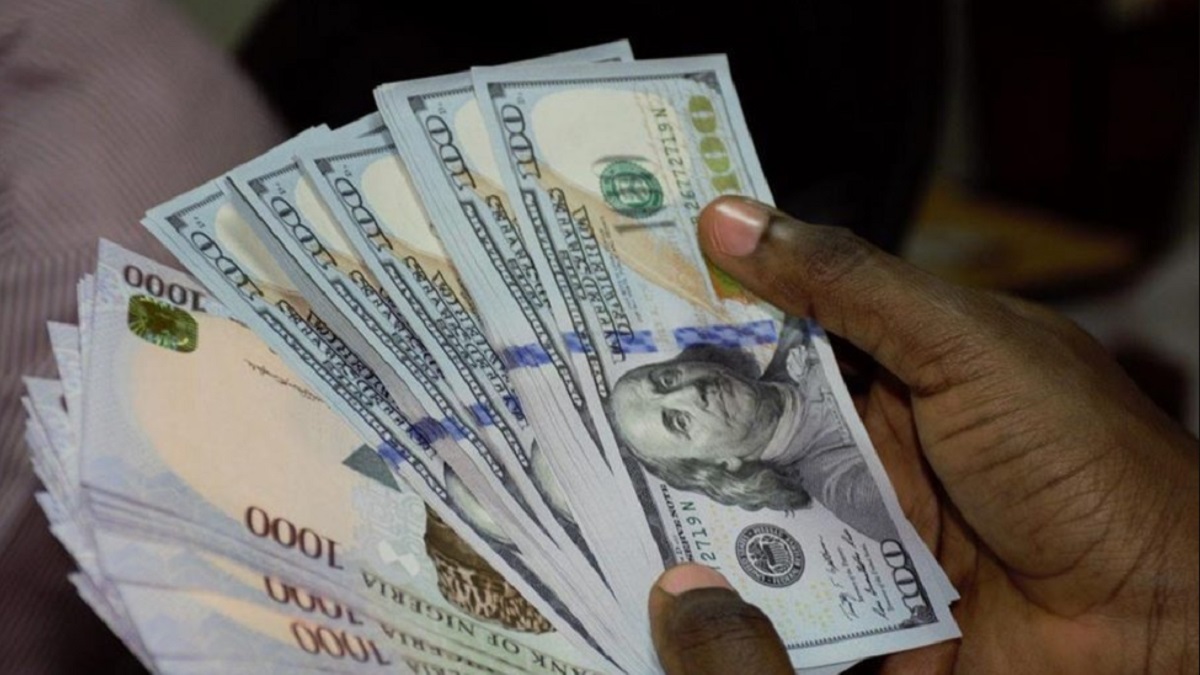
Naira to Settle at N1,250 per US Dollar in 2024 – Report
Naira exchange rate has been forecasted to settle at N1, 250 per US dollar, much lower to current spot rate in the official window in 2024. The local currency has been under pressure after the apex bank devaluation in mid-2023.
BMI report, a Fitch Solutions company said in its sub-Saharan African (SSA) currency note that the Nigerian naira has exhibited significant volatility in recent months, adding that most of the weakness is now behind it.
FX liquidity has remained pressure cooker in the local currency markets. The apex bank reform however attracted FX inflows after series of policies support, but foreign currency demand has rose to match the momentum.
In a report, the Institute of International Finance, said policy changes made by President Bola Tinubu last year were deemed necessary, but acceleration and greater cohesion of orthodox policies across the board are needed.
The institute noted however that continued devaluations, without appropriate policies, are most likely a fool’s game. Exchange rates have plummet after the CBN withdrawn support for the naira at the official and parallel market.
Fitch Ratings had projected that the naira will end the year at N1,450 while Goldman Sachs set its expectation at N1,000 as the apex bank claimed the local currency is grossly undervalued.
Following the devaluation in January – when the Central Bank of Nigeria (CBN) changed the methodology it uses to set the official rate – the gap between the official rate and the widely used parallel market rate has closed, pointing to some reform progress, according to the report.
Analysts said despite this, the naira has remained weak, having lost 7.3% of its value against the US dollar in the months after the January devaluation.
The naira plunged as US dollar demand outstripped supply due to fund repatriation following the CBN’s clearing of its backlog of foreign exchange requests and a continued dependency on imported petrol.
“Over the coming months, we forecast the Naira to strengthen to NGN1,250 by the end of 2024, from the July 8 spot of NGN1,524”, Fitch Solutions said.
Analysts said the projection rests on two key assumptions that Dangote Refinery would start producing petrol to local market and Central Bank of Nigeria shift to greater monetary orthodoxy.
“First, we expect the Dangote refinery—which commenced operations in January 2024—to start producing and supplying petrol to the local market from July.
“This will reduce Nigeria’s refined liquids trade deficit from 493,000 barrels per day (b/d) in 2023 to 228,000 b/d in 2024, thereby lowering the demand for dollars to finance fuel imports.
“Second, we expect that the CBN’s shift to greater monetary orthodoxy – that is a more hawkish policy stance – will improve dollar inflows”. Fitch Solutions said in its premium report.
Indeed, portfolio inflows already increased by 220% year on year and 570% quarter on quarter in Q1 2024, a trend that analysts expect to continue to greater dollar supply in the months ahead.
In the report, Fitch Solutions also stated that external conditions will offer more support to SSA currencies in the coming quarters.
Following a prolonged period of weakness, and amid easing inflationary pressures, the majority of SSA currencies are now undervalued against the US dollar in real effective exchange rate terms, which will likely limit the scope for further sharp losses in the near term.
The firm said analysts expect monetary easing in the US to commence in September, a move which will weigh on the dollar’s strength and improve the relative attractiveness of riskier but higher yielding emerging market assets.
“Taken together, we expect these dynamics to ease downward pressure on SSA currencies in H2 2024. We anticipate greater stability for Sub-Saharan Africa’s major currencies in H2 2024”, the report added.
In 2023, most currencies in the region fell sharply against the US dollar – with many either depreciating further or experiencing heightened volatility in H1 2024.
Over the coming months, analysts said they expect some of the region’s hardest-hit currencies (namely the Nigerian naira, the Ghanaian cedi, and the Zambian kwacha) to exhibit more stability, thanks to improved investor sentiment, higher dollar inflows, and easing external conditions.
Conversely, the report expects the South African rand, the Kenyan shilling, and the Angolan kwanza to depreciate somewhat by end-2024, due to a combination of political uncertainty, elevated dollar demand, and reduced central bank intervention. Dangote Refinery, Fertilizer Coy to Be Listed in Q1 2025
