

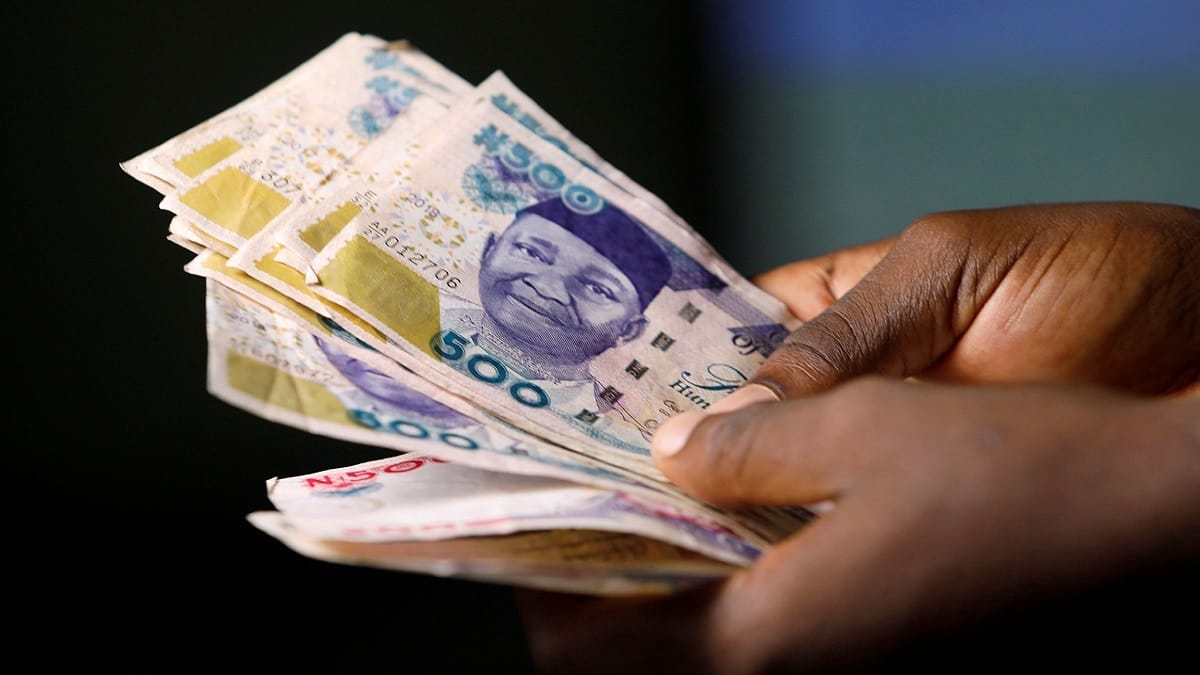
Naira to Hit N440 at Official Window, Analysts Say
Without addressing pressure on demand for the United States dollar in Nigeria, a resultant result of low foreign receipt from Nigeria’s exports, devaluation of Naira will continue to be useless, MarketForces Africa gathered from experts in the financial markets.
However, in their separate macroeconomic notes on Naira, in what looks like a consensus, Nigerian investment banking firms are expecting the local currency to be devalued – again. Pre-election year demand for the dollar is among the factors that will pressure the exchange rate, according to analysts.
In late December, Central Bank allowed Naira to shed about 5% of its value at the Investors and Exporters foreign exchange window. However, the naira has since early January reversed to N416.50 as the local currency holds strong.
In 2022, most conservative investment banking analysts projected the local currency to be devalued between the range of N430 and N440 to a United States dollar.
Based on historical antecedents, an expectation of higher demand for the United States dollar would have a rumple effects on the Nigerian local currency, naira across the foreign exchange markets.
Despite a bleak outlook, some analysts believe that the Central Bank would not devalue the local currency, though overvalued based on the real effective exchange rate (REER).
“Central Bank (CBN) would not toll the line of devaluation until pressures build. However, with more than $40 billion in external reserve, monetary authority will continue to fight in the FX markets”, a Lagos-based economist who prefers not to be mentioned told MarketForces Africa.
An investment expert, Kingsley Aigbe, CFA told MarketForces Africa last year that CBN is only delaying the inevitable. Godwin Emefiele, CBN Governor acknowledged at an investor’s forum that Naira was overvalued.
However in December, the apex bank allowed the depreciation of naira at the Investors and Exporters foreign exchange market to slide to N435, there had been initial demand/supply-driven pressures when naira crossed N420.
In its outlook for the year, CardinalStone said indicators of FX valuation suggest that the Naira remains overvalued and could weaken to N440.00 to a dollar in 2022.
“While a weaker currency regime could encourage foreign inflows, the issue of dollar demand backlogs would need to be addressed, and the overall FX liquidity framework improved to enhance investors’ confidence”.
In addition, CardinalStone stated in the note that foreign investors may require an enhanced carry trade that reflects Nigeria’s risk environment, especially in the pre-election year 2022.
Though FSDH sees naira as overvalued, the investment banking firm projected that the local currency will be devalued to N430 in 2022. Based on the latest data as of the second quarter of 2021, the CBN estimated the fair value of Naira at N462.00, which implies a 12.3% overvaluation versus the Investors and Exporters FX rate, according to CardinalStone.
To curb inflationary pressures and avoid a worsened currency position, analysts at the firm think that the CBN is unlikely to adjust the Naira to N462.00, hence projecting a Naira fair value of N440.00 per dollar in 2022
The nation’s external reserves, which opened the year at US$35.6 billion, crossed US$40 billion, and it closed at the same range despite CBN FX market intervention.
Dollar inflows were recorded from the approval of the US$3.35 billion Special Drawing Rights (SDRs) by the International Monetary Fund (IMF) in August 2021. Also, Debt Management Office raised US$4 billion raised from the issuance of Eurobond in September.
Despite much higher reserves, Nigeria still struggles with challenges of low crude oil production, limited investment inflows and high demand for foreign exchange.
The Naira depreciated on the Investors and Exporters (I&E) Window by 4.1% to N410 per dollar in the first quarter of 2021 from N394 in the fourth quarter of 2020.
In its macroeconomic note, FSDH Capital noted that Nigeria’s investment inflows fell significantly in the second quarter of 2021. Analysts stated that in the period, investment inflows declined by 54% to US$875.6 million from US$1.9 billion in the first quarter.
“Even at the height of the pandemic in the second quarter of 2020, investment inflows (US$1.29 billion) was much higher than what was recorded in the second quarter of 2021”. In the first half of 2021, total investment inflows into Nigeria was US$2.78 billion, far lower than US$7.15 billion in the comparable period in 2020, according to FSDH Capital.
It was noted that inflows declined across all categories – FDI, FPI and Other Investments – mainly due to heightened insecurity and foreign exchange restrictions. The exchange rate was relatively stable in the second half of 2021.
The issuance of the Eurobond and drawings from the SDR in late 2021 improved external reserves position in the third quarter, thereby resulting in stable rates in the Investors and Exporters FX window. But external reserves have since been under pressure following limited investment inflows and high dollar demand to finance goods import and services.
“Pre-election periods in Nigeria are often associated with heightened uncertainty. In view of this, as well as the insecurity situation, we believe that investors will be cautious and Nigeria could experience limited foreign exchange inflows during this period”, according to FSDH Capital note.
Analysts wrote that the extent of depreciation, will, however, be determined by inflow from the sale of crude oil, which is influenced by crude oil price and output.
“We estimate that the Naira will settle at N430 per US dollar towards the end of 2022”, FSDH analysts stated. #Naira Skids at Official, Parallel Markets as Oil Receipts
