

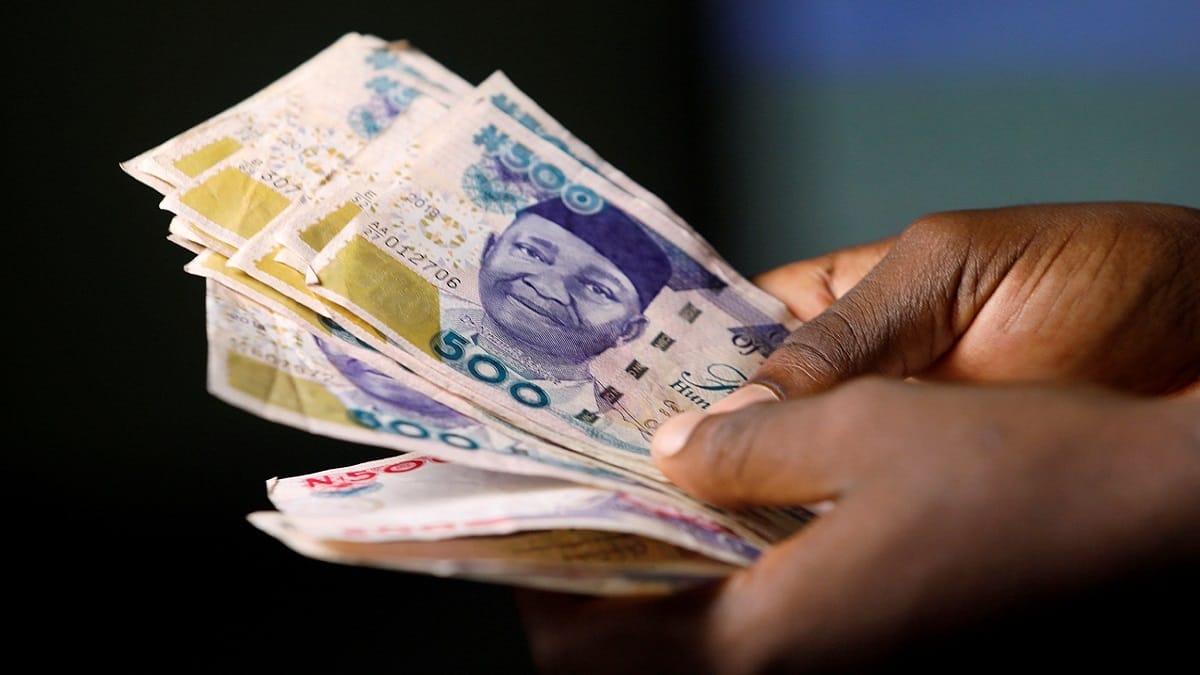
Naira Sinks as Demand Pressure Deepens, Devaluation Not Impossible
Naira, the Nigerian local currency, sinks as demand continues to rise despite lower market supply arising from weak oil export receipts at the time foreign portfolio investors’ apathy in the economy remains loud and clear.
The Central Bank of Nigeria (CBN) is merely postponing the inevitable, an investment banker told MarketForces Africa, saying that the local currency is heavily overpriced at the current level.
Both official and parallel markets have continued to reprice the spot rates for the local currency, though the apex bank maintains its stance not to devalue Naira due to the impacts of unhedged private contracts, and the economy at large.
Pre-election demand is expected to force the monetary authority to tighten reins on the local currency exchange rate, MarketForces Africa gathered from experts. This could mean another devaluation is not impossible.
Foreign currencies scarcity has persisted due to low dollar inflow from oil sales. This has been worsened by the dearth of foreign direct and portfolio investments into the country amidst unpriced political, economic and security risks.
Pressures continue to mount on the local currency as foreign investors are still unable to repatriate funds abroad. The apex bank continues to implement capital control measures to keep the local currency strong.
“Getting dollars out of Nigeria is difficult”, the MTN group told investors conference at a meeting. Multichoice, owners of Dstv, Gotv confirmed the trend last year to investors. MSCI Index had also warned over a possible downgrade of the Nigeria index.
Naira continues to free falling due to weak market intervention. External reserve trend behind $40 billion mark despite higher oil price and Eurobond raise. The sum in the foreign reserve has been unstable as import bills outpaced export receipts, a government revenue driven by foreign currencies earnings from hydrocarbon sales.
But a lower volume of production held back Nigeria from benefiting from the oil windfall. Market data shows that Nigerian Bonny light price inched upward to $111.15 per barrel as China eased lockdown in COVID-19 ravage cities including Shanghai in the just concluded week.
Angola and Nigeria were noted to account for the Organisation of Petroleum Exporting Countries (OPEC) and allies’ weaker oil production in the first quarter. Nigeria’s production volume fell by 400,000 barrels per day, according to Argus media.
FX rates worsened last week in the official and parallel markets due to rising pre-election demand for foreign currencies. At the Investors and Exporters foreign exchange window, the foreign exchange rate depreciated against the greenback by 0.001per cent to N420.33 a United States dollar, data from FMDQ Exchange shows.
Pressures were heavy on the local currency in the black market as Naira depreciated against the greenback at the parallel market by 19.24 per cent to close at N600.00 to a dollar. In some segments, the dollar was offered at a range of N601 to N606 to buyers.
At the Interbank Foreign Exchange market, the foreign exchange rate closed flat at N430.00 for a dollar amid CBN’s weekly injections of $210 million last week. Of the sum injected, $100 million was allocated to Wholesale Secondary Market Intervention Sales (SMIS), $55 million was allocated to Small and Medium Scale Enterprises and $55 million was sold for Invisibles.
Meanwhile, Cowry Asset Management analysts said in a report that the exchange rate traded in a mixed direction across the foreign exchange forward contracts. 2 month, 3 months and 12 months contracts gained 0.05 per cent, 0.05 per cent and 0.18 per cent to close at N420.92/$, N423.80/$ and N448.02/$ respectively.
However, 1 month and 6 months contracts lost 00.11 per cent and 0.01 per cent to close at N418.46 per dollar and N432.66 respectively. “We expect some level of pressure on the Naira against the greenback due to anticipated pressure on foreign exchange amid electioneering activity coupled with weak petrodollar earnings”, the firm said.
Elsewhere, Nigeria’s external reserve sustained its descent for the third consecutive week, as it fell to its lowest level since 8 October 2021, Cordros Capital said. Specifically, the reserves declined by $175.17 million week on week to $38.84 billion as CBN maintains FX market intervention, though foreign currencies inflows remain tight.
In its market report, Afrinvest said activity level at the Investors and Exporters FX window dampened 6.2per cent week on week to $622.98 million compared to $664.2 million recorded in the previous week.
Analysts said they do not expect the FX market to significantly deviate from the current trend. It was noted that if CBN failed to reprice the Naira, FX rates across the markets are not expected to get any better.
In April, inflows to the Investors and Exporters Window (IEW) rose by 38.9% month on month to $1.58 billion, albeit 61.9% below the pre-pandemic level of $4.14 billion recorded as of February 2020, according to Cordros Capital.
Analysts highlighted that the increase reported during the month reflects higher inflows across the local which surged 39.9% to $1.24 billion and foreign sources, up +34.1% to $340.60 billion in April 2022.
Notably, analysts said the inflows from the exporters grew +81.0% month on month to $429.5 million, the highest level since the CBN created the window, reflecting the initial impact of the CBN’s non-oil export proceeds repatriation rebate scheme.
Despite proceeds from the $1.25 billion Eurobond issued in March, the gross FX reserves have declined by 4.0% on a year to date basis. At $38.88 billion, Cordros capital analysts said the gross FX reserve is at its lowest level in seven months. The decline suggests that the country is yet to benefit from the rally in crude oil prices, given low crude oil production volume and elevated subsidy payments.
“We expect the gross external reserves at current levels to comfort the Committee that it has enough liquidity to maintain periodic FX intervention, albeit at a pace substantially below pre-pandemic levels”. #Naira Sinks as Demand Pressure Deepens, Devaluation Not Impossible
