

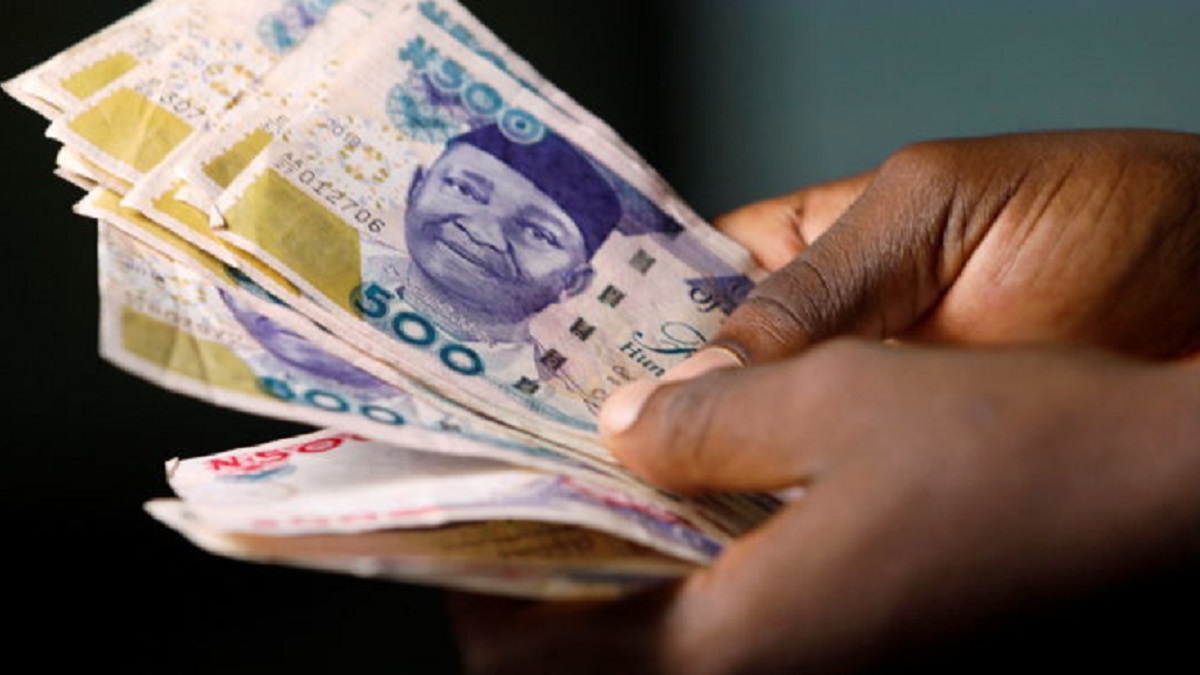
High FX Demand Suffocates Naira, Parallel Market Rate Exceeds Official by N88
Traded near N1538, an untamed demand for the US dollar further exacerbates existing pressure on the naira at the official window, according to data from FMDQ, a platform that publishes daily exchange rates in Nigeria.
Analysts said the Naira depreciation to N1537.96 per US dollar in the official market suggests that foreign currency inflow has not improved as demand outweighed what the market could supply.
To boost forex market liquidity, the CBN conducted FX market intervention, selling about USD170.00 million to banks, according to Cordros Capital Limited which also stated that trades were consummated at the official window within the N922.38 – N1,607 per US dollar.
However, the US dollar sales to local deposit money banks and other authorised dealers called FX market intervention – which the apex bank had stopped for more than four months- failed to upturn the exchange rate direction.
In the parallel market, the exchange rate crossed a new red line amidst rising demand, a low supply equation which has become a nightmare for Africa’s largest economy by gross domestic product size estimated at $500 billion.
As a result of sustained demand on account of Nigeria’s high import record, the gap between official and parallel market rates widened to N88 for each US dollar request and supply. This is a reversal from the previous week’s data when the official exchange rate exceeded FX quotes at the parallel market by N46, according to MarketForces Africa’s FX tracker.
Recall the Central Bank of Nigeria (CBN) floated the naira to obtain a market clearing rate and reduce FX gap between the official and black market rates. Spread had widened strongly in the recent past; creating incentives for currency traders and banks to speculate.
According to analysts who spoke with MarketForces Africa, the downside to the naira recovery includes high imports taste, an increase in corporate demand for unfinished goods, and raw materials. These seemingly inelastic demands from rational market demand have continued to strengthen foreign currencies including the US dollar, British Pound and Euro.
Despite the apex bank’s renewed foreign exchange market intervention, exchange rates worsened across the official, and official markets as the US dollar shortage challenge persisted. Recently, the central bank rolled out three new circulars, all focused on checking potential infractions on the demand side.
The CBN directed all authorised dealer banks to restrict personal and business travelling allowance (PTA/BTA) payout to electronic channels only, including debit and credit cards. It also revised upward, the allowable limit of price deviation for exports and imports to -15.0% and +15.0% of global average prices respectively from -2.5% and +2.5% previously – citing global inflation dynamics and other related challenges as reasons for the review.
Earlier, the CBN last week directed banks to limit cash pooling on behalf of international oil companies (IOCs). Effectively, the apex bank has set a 50% of FX revenue as the amount IOC can transfer offshore to parent accounts. According to the circular, the remaining 50.0% can be upstream after 90 days from the date of an inflow of export proceeds subject to the fulfilment of all documentation requirements.
Nigeria’s foreign reserve gained 0.4% week on week to $33.3 billion. In contrast, the activity level in the Nigerian Autonomous foreign exchange market (NAFEM) window waned 58.1% to $1.2 billion, according to top investment banking firm, Afrinvest Limited.
In the parallel market, the exchange rate worsened to ₦1,625.00, implying a 9.5% depreciation in the value of the local fiat over a week. In its market update, Afrinvest anticipates that the Naira would remain pressured across market segments in the absence of significant inflows to boost FX liquidity.
However, currency pressures remain heightened as FX shortages persist in the face of a largely constrained external reserves position, limited crude oil output, an FX backlog and past-due FX forwards. Analysts remained positive, saying that Nigeria’s economic growth is hinged on the continued implementation of macro-fiscal and inclusive structural reforms.
#High FX Demand Suffocates Naira, Parallel Market Rate Exceeds Official by N88 #Selloffs Provoke Spike in Nigerian Treasury Bills Yield
