

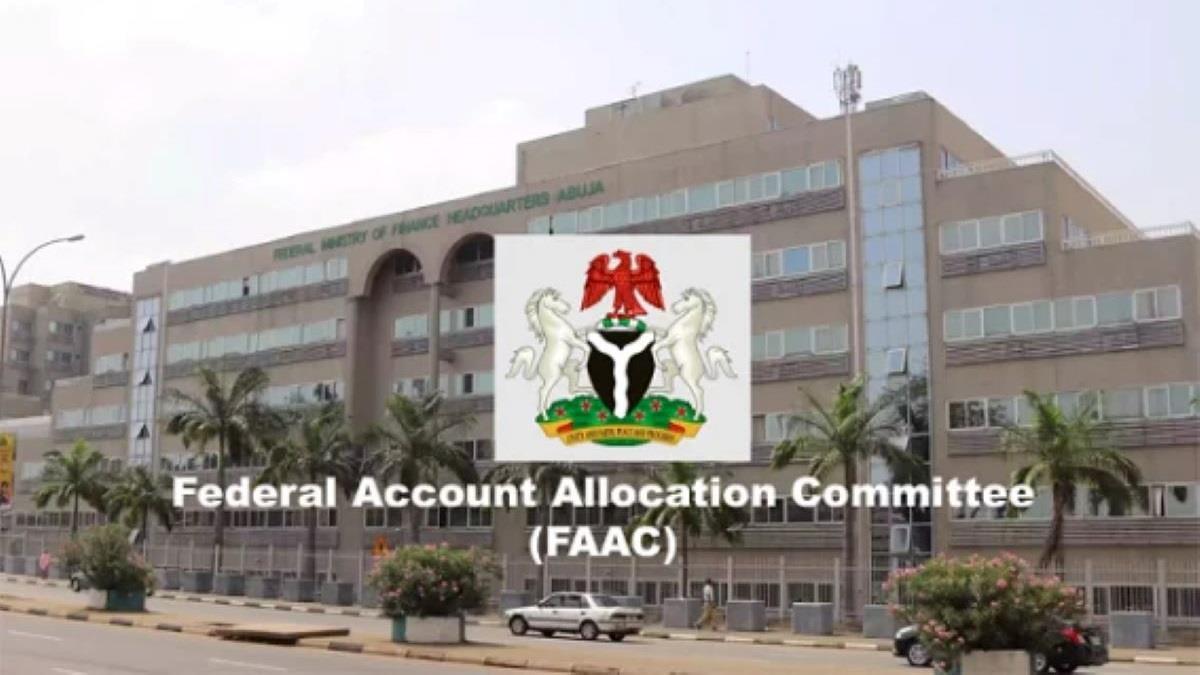
Total Allocation to FG, States, LGs Rises by 50% in N16.45trn
Over a span of nine months, the Federal Government (FG), along with state and local authorities, has obtained N16.45 billion from revenue collected at the federal level, marking an approximately 50% increase compared to the same timeframe in 2024.
The Federation Account Allocation Committee (FAAC) continued its upward trajectory in 2025, marking one of the strongest fiscal performances in recent years.
Nigeria’s fiscal strength has been bolstered since removal of subsidy on petroleum, raising monthly allocation to tiers of government in multiple folds. Though more money flow through three states, local government, and central power, development has not seen drastic upgrade.
Most of capital spending channel to infrastructure development are laced with high costs above standard in other frontier, and emerging economies.
The immediate outcome of reforms in Nigeria transferred wealth to the authorities, leaving the private sector struggling. But analysts anticipate things to normalise for private sector growth as macroeconomic indicators begin to recover.
While tiers of government thrive in terms of fiscal flows, many companies failed to survive high interest rate environment spurred by double digits high headline inflation, depreciated local currency and thinning consumer wallets.
Between January and September 2025, a total of N16.45 trillion was shared among the three tiers of government, representing a 49.6% increase year-on-year from the N10.9 trillion distributed over the same period in 2024.
In its commentary note, Cowry Asset Limited said this sharp rise underscores a combination of improved oil revenue performance, enhanced tax remittances, and the gradual normalization of Nigeria’s fiscal operations following the distortions of the 2023–2024 exchange rate realignments.
“The breakdown reveals that the Federal Government received N5.66 trillion, accounting for about 34% of the total pool. This represents a 59% year-on-year increase, the most significant growth among the tiers.
State governments collectively received N5.52 trillion, up by 47.3%, while local governments earned N4.04 trillion, a 48.2% increase over the corresponding period of 2024.
The 13% derivation fund, which benefits oil-producing states, also grew modestly by 27.6% to N1.23 trillion, reflecting an improvement in crude oil output and remittance efficiency by key upstream operators.
The pattern of monthly allocations highlights the increasing liquidity that has flowed into the public sector since the start of the year.
From an average monthly disbursement of just above N1.1 trillion in the first half of 2024, allocations have steadily expanded, crossing the N2 trillion mark in July and August 2025, when FAAC distributed N2.00 trillion and N2.23 trillion respectively — the highest monthly disbursements on record.
The combination of elevated crude oil prices in the international market, higher domestic oil production volumes, and stronger performance from non-oil tax agencies such as the Federal Inland Revenue Service (FIRS) and the Nigeria Customs Service, all contributed to the enlarged fiscal envelope.
Interestingly, the composition of FAAC inflows reveals a structural shift in Nigeria’s revenue profile in 2025. Unlike the preceding year when foreign exchange revaluation gains boosted public revenues, the 2025 performance has been driven largely by core statutory and tax-based income.
Statutory allocations rose sharply by 71.2% to N9.35 trillion, supported by higher crude royalties, company income tax, and customs duty collections. By contrast, exchange gain revenues declined steeply by 88.4% to just N699 billion, as the naira stabilized following its sharp depreciation in 2023–2024.
This decline, while reducing the FX windfall component, signals a welcome return to more sustainable, production-driven revenue growth. Similarly, value-added tax (VAT) collections, which have become a critical non-oil revenue pillar, stood at N5.97 trillion between January and September 2025 — a marginal 2.2% decline compared to the previous year.
The moderation in VAT performance likely mirrors softer household consumption and business activity amid still-elevated inflation and high-interest rate conditions.
The Electronic Money Transfer Levy (EMTL), another non-oil revenue line, generated N326 billion YTD, down from N782 billion in 2024, as transaction volumes in the digital payments space normalized after two years of accelerated growth.
The strong inflow to the Federation Account in 2025 has had visible fiscal implications at the subnational level. Many states have reported improved liquidity positions, enabling them to meet recurrent obligations such as salary payments, pension arrears, and in some cases, increase capital expenditure.
The higher FAAC inflows have also supported local governments, many of which depend almost entirely on monthly allocations to function.
Nevertheless, the distribution pattern continues to underscore Nigeria’s fiscal centralization — with the Federal Government and states accounting for over two-thirds of total disbursements, leaving local councils still fiscally constrained”.
From a broader perspective, Cowry Asset Management Limited said the 2025 FAAC trajectory reflects a system gradually rebalancing from FX-driven windfalls to organic revenue growth.
The investment firm stated that the shift, though positive for fiscal sustainability, introduces new challenges: with limited exchange rate revaluation gains and only moderate improvement in oil output.
Analysts said the scope for further revenue expansion may narrow unless tax efficiency, compliance, and diversification deepen.
“Going into the final quarter of 2025, FAAC inflows are expected to remain robust but may begin to stabilize around the N1.8–N2.0 trillion monthly range, depending on oil market dynamics and fiscal operations.
“With oil production currently averaging between 1.4 and 1.5 million barrels per day and global prices hovering near the $80 per barrel mark, Nigeria’s fiscal outlook remains cautiously optimistic.
“However, rising recurrent spending pressures — including wage adjustments and debt servicing costs — may continue to test the government’s fiscal discipline,” Cowry Asset Limited said in its commentary note. Ikeja Hotel Grows Profit by 285%, Announces Interim Dividend
