

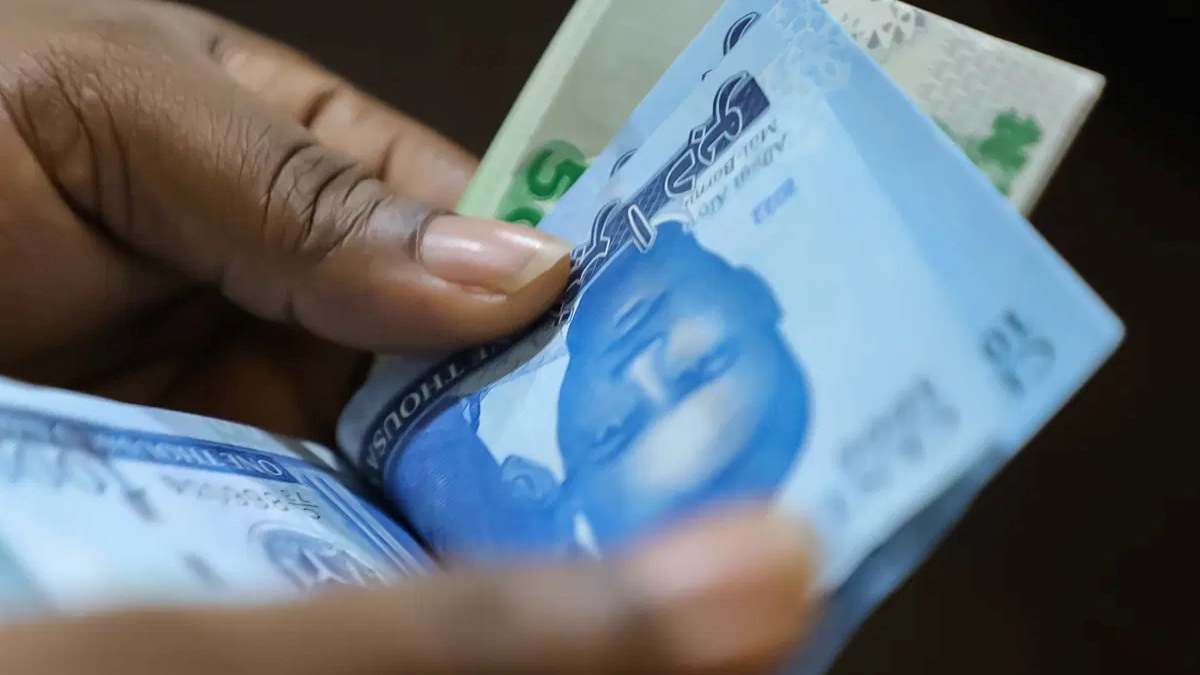
Naira Gains as Hydrocarbon Sales Proceeds Boost FX Reserves
The naira rallied against crosses in the currency market as proceeds from Nigeria’s hydrocarbon sales continue to boost the country’s foreign reserves.
According to daily FX data released by the Central Bank of Nigeria (CBN), spot FX rate closed at N1366.7950 per US dollar at the official window, from N1373.2445 at the close of the session on Friday.
The official rate hovered between N1360 and N1374.5000 per dollar during the intraday trading session, reflecting absence of significant dollar demand.
The British pound closed at N1832.6115, the euro traded at N1586.5418, while the yen settled at N8.5532, a daily FX update from the Central Bank showed.
In the parallel market, the naira rose against the US dollar to ₦1,375/$ per dollar, reflecting broad-based buying interest in the local currency across both the official and informal foreign exchange segments.
Broad Street analysts maintained a bullish outlook on the local currency, a view supported by the Central Bank’s FX interventions at the official window. Analysts believe that growing external reserves will give the authority a strong buffer to defend the local currency to achieve stability.
Nigeria’s gross external reserves settled at $49.58 billion at the end of May, a sharp rebound from the previous downtrend, driven by foreign debt service and FX intervention in the official window.
The improvement in reserve levels was likely supported by increased foreign exchange inflows, particularly from crude oil export proceeds, amid sustained strength in global oil prices.
`U.S. oil prices jumped 5% Monday after President Donald Trump told CNBC he did not care if talks with Iran come to an end, stoking market fears that negotiations have collapsed.
West Texas Intermediate futures rose 5% to $91.78 per barrel by 1:33 p.m. ET. The international benchmark Brent crude advanced about 4% to $94.99 per barrel.
Trump was responding to an Iranian state media report that Tehran will halt talks with the U.S. in response to Israeli attacks in Lebanon. Iran will also completely close the Strait of Hormuz, state media said.
“I really don’t care. I couldn’t care less,” Trump told CNBC’s Eamon Javers in a phone interview when asked whether negotiations are over. “I think they took too much time. Frankly, I thought they started to get very boring.”
Oil prices pulled back from session highs after Trump subsequently said on social media that Prime Minister Benjamin Netanyahu agreed Israeli troops will not advance to Lebanon’s capital Beirut.
U.S. crude prices spiked more than 8% earlier in the session as the market feared talks between the U.S. and Iran had collapsed. Trump told CNBC he wasn’t worried about rising oil prices.
“I think the oil will be dropping like a rock in the very near, you know, the very near distance,” Trump said.
Iran is demanding that Israel halt attacks in Gaza and withdraw from occupied areas in Lebanon for talks with the U.S. to resume, according to the state-affiliated news agency Tasnim.
Tehran will completely block the Strait of Hormuz and open other fronts, including the Bab el-Mandeb Strait, Tasnim reported. Bab el-Mandeb is a trade chokepoint that connects the Red Sea to the Gulf of Aden.
Brent and WTI closed off by 11.1% and 9.6% last week, respectively, notching their worst weekly performance since mid-April. The contracts remain up by about 30% since the U.S. and Israel-led war against Iran started on Feb. 28.
The U.S. and Iran launched fresh strikes, and Israel ordered troops to push deeper into Lebanon over the weekend, renewing concerns that clashes with the Iran-backed Hezbollah group threaten a fragile ceasefire between Washington and Tehran. Nigerian Exchange Shrinks as Equities Investors Lose N1.8trn
