


Debt to Revenue Ratio in SSA Region Estimated to Cross 480% in 2020
Following the recent external financing needs due to COVID-19, debt to revenue ratio has been estimated to reach over 480% across 35 Sub-Saharan African (SSA) countries that are eligible for the G20 Debt Service Suspension Initiative (DSSI)—an increase of more than 100 percentage points.
The Institute of International Finance, IIF, made the disclosure in a report.
Sub-Saharan African countries have been bleeding due to high debt profiles which has been estimated to be higher than their historical revenue generations.
The region has featured prominently among the vulnerable low-income countries that have seen an unprecedented surge in government financing needs as the COVID-19 pandemic wears on.
Stakeholders think there will be more pressure following increased in demand for external support in African Countries, especially those within SSA region.
In Nigeria, total debt exposure has crossed N30 trillion, yet revenue generation capability has remained tight band.
Following unstable movement in global price of crude oil, and supply cut as demanded by the Organisation for the Petroleum Exporting Countries, Nigeria’s revenue estimate is expected to underperform.
While borrowing should not be an issue for any sovereign, ability to pay back without overloading annual budget with debt service cost is key.
Unfortunately, governments in the region have been unable to change the pattern and year on year pressure on budgets persist.
In a report, the Institute of International Finance, IIF, said the sudden stop in cross-border investment, trade, and tourism flows has greatly weakened the budget balances of many sovereigns while undermining their revenue generation capacity.
The Institute said in a report that in 2020 the government debt-to-revenue ratio will reach over 480% across the 35 Sub-Saharan African (SSA) countries that are eligible for the G20 Debt Service Suspension Initiative (DSSI)—an increase of more than 100 percentage points.
Although debt ratios are expected to start declining once countries start to recover, new (low tourism) and lingering (low tax base) challenges in revenue generation will likely keep external financing needs at elevated levels going forward, IIF stated.
“We estimate gross 2021 external financing needs of DSSI eligible SSA countries at $127 billion (9.7% of GDP)—only slightly lower than the $133 billion (10.8% of GDP) seen in 2020”, the report explained.
However, IIF noted that striking differences persist across countries with financing needs in 2021 varying from 2.5% of GDP in the Comoros to near 100% in Mozambique.
Of note, external financing needs are expected to account for more than 20% of GDP in Angola, Burundi, Liberia, Malawi, Niger, Mozambique, and Zambia next year.
With debt service payments to foreign investors making up half of gross financing needs in 2021-2022, it will be critical for low-income countries to improve their revenue generation capacity.
They will need to also maintain/expand international market access—both for pandemic recovery and to achieve the UN’s Sustainable Development Goals.
At present, IIF said official bilateral and multilateral creditors comprise the majority of all external creditors for many LICs.
The surge in total external debt across the 35 DSSI eligible SSA countries over the last decade (from $145 billion in 2009 to $382 billion in 2019) has largely been driven by public and publicly-guaranteed (PPG) debt (above $270 billion), of which official creditors hold 70%.
With strong bond issuance activity in recent years, the rise in debt held by foreign private creditors has been striking, increasing from $15bn in 2009 to over $80bn in 2019.
At present, the private sector represents the largest portion of PPG external debt for 10 countries in the DSSI-eligible SSA universe.
Since the start of the pandemic, however, IIF said there has been no new international bond issuance from these countries—in contrast to the pick-up in issuance activity in other EMs and frontier markets.
While this partly reflects the adverse impact of higher borrowing costs in secondary markets, the wave of recent ratings downgrades appears to have weighed on many sovereigns’ appetite to tap capital markets despite improving global liquidity conditions.
Notably, issuance has also been subdued in domestic debt markets compared to previous years.
It stated that the pandemic has also prompted a reversal in cross-border banking inflows.
BIS-reporting banks cut exposure to DSSI-eligible SSA countries by $2.4bn in Q220.
However, the retrenchment in flows was smaller than during the peak of the 2008/9 global financial crisis and was largely concentrated in Angola and Liberia.
Excluding these two countries, banking inflows remained in positive territory.
Overall, 16 DSSI-eligible countries continued to attract net banking inflows, highlighting the willingness of private sector creditors to continue supporting these countries.
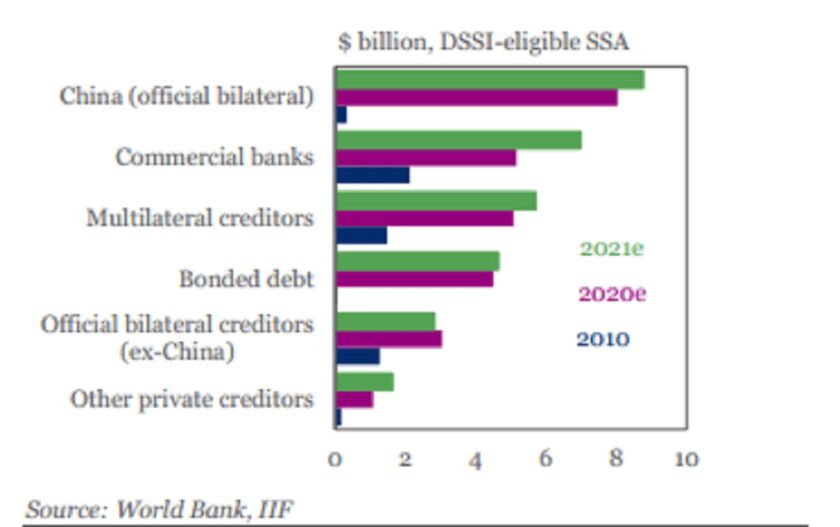
“Looking ahead, external debt service payments on PPG debt across the 35 countries will amount to roughly $30.5 billion in 2021—slightly higher than the 2020 number”, IIF estimated.
World Bank estimates suggest that nearly 30% of the total is due to official bilateral creditors in China, and other bilateral creditors represent an additional 10%.
Read Also: Nigeria’s Ballooning Debt: Don’t Panic, China is not the Devil
IIF said while commercial banks account for over 20% of estimated debt service payments in 2021, the limited data available suggest that over 55% of the repayments to commercial banks appear to be associated with the China Development Bank.
Debt to Revenue Ratio in SSA Region Estimated to Cross 480% in 2020
