


Perspective: Is there Food Crisis in Nigeria?
Nigerians are not finding it funny with the multiple increase in prices of foods and household items. For most Nigerian labour force, their monthly take home cannot take them two weeks before they result to borrowing.
All key macroeconomic indices are working against average Nigerians. Now, it is either you are rich, or you are poor. Foods items for below average Nigerians in low income bracket have gone out of reach. Would poor man be able to feed, again?
Federal Government minimum wage equates a bag of rice or two bags of gaari under President Muhammadu Buhari led APC government – this is the worst ever seen in the history of the nation!
Something must explain why prices of food and other households items are on the high side in recent time while households earnings shrink. Unemployment rate at 33.3% is hard to bite, thanks to Nigerians survival instincts.
Is demand more than supply? Can the country produce efficiently what more than 200 million Nigerians need? Do we have enough external reserve to satisfy imports appetite?
First, Federal Government border closure policy worsened supply of food items with limited local supply as insecurity continues to hamper agricultural harvest. Consumers price index has been on the rise for 19-month straight, largely on the back of steep increase in food index. 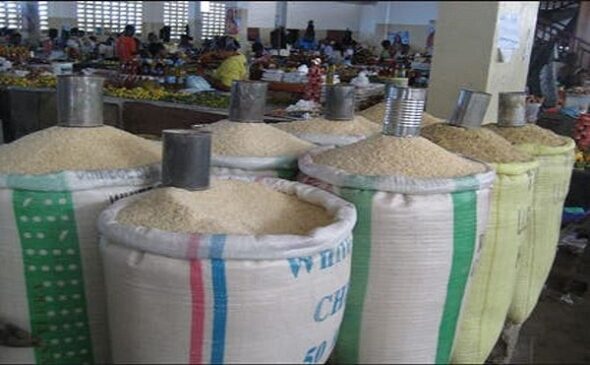
Taking a look at how prices of food items in the market is changing, one may be tempted to say there is food shortage in Nigeria today.
Is there not? Or the development is purely shift in wealth distribution to key farmers in the agricultural sector?
Or perhaps, from commercially savvy segment of the economy to farming communities? Federal Government does not think or have policy to effectively manage food supply chain.
A bag of locally produced rice in the market goes for N25000 to N30,000 while foreign rice is selling between N32,000 – N45,000 in some quarters. A paint of gaari – N1,000, Rice – N2,200, Beans N2,100.
Bag of gaari, beans and other what poor class used to call normal food items are now out of reach. A 5 litre of local oil in the market is about N2500 while onions are relatively scarce, thus explain its steep price.
Poor policy and lack of understanding of the Nigerian states chemistry appears to bear on food inflation. It would have been easy for President Muhammadu Buhari to duplicate 1983 price control used to stem instability. Nay, this is democracy.
It would be recalled that before border closure policy, locally produced rice were bought by those in the very low income brackets. With border closure, demand for locally produce rice skyrockets while the supply side grow but slowly.
In the meantime, Nigerians have to produce what Nigerians will eat – irrespective of efficiency, price charge or quality delivered. Despite high price Nigerians are paying for foods items, income level continues to drop as misery index widened.
It would be recalled that the Federal Government locked down land borders in August, 2019 believing that Nigeria has enough to feed its people. Or at least, to support local production of foods and encourage industries to thrive.
This, often times, is what countries that have poor local advantages do to protect their local industries. Given the nation’s consumers size, this is encouraging but the policy worsen situation due to poor timing.
Prices of locally grown foods have become more expensive, and this has turned to a normal pattern with no end in sight.
True to the game plan, the Nigeria’s central bank has been supporting agricultural sector with various financing initiatives.
The apex bank’s anchor borrower program had stronger coverage than any of its agricultural financing initiatives.
However, it appears that North, which has often been taunted as food support base of the nation, has largely disappointed the nation.
The whole nation is at the mercy of agricultural food supply from farms across the nation, much of these are from Northern part of the country.
Demand side has come stronger than what the agricultural sector can fill, therefore prices have been skyrocketing amidst peanut minimum wages in the country.
In dollar term, minimum wage is less than $70.
It therefore means that the nation’s minimum wage does not accord civil servants right to buy a bag of rice in the open market after 30 days. Civil servant below grade level 10 in the minimum wage class that goes to market and buy a bag of rice must be probed.
In terms of price, Nigerians expectations were dashed after prices of bag of local started trailing price of smuggled foreign rice.
As a matter of fact, both foreign and locally grown rice in the market places are trading just a few margin away. It is that bad that other daily needs have the same issue.
Home competition is now inefficiency versus inefficiency in a country with very poor competitive and comparative advantages. The coast is not going to be cleared so soon without putting anchor borrower funds in the hands of the local farmers in jeopardy.
Recall that some Northern part of the countries recently experience flood, and some rice farms were noted to be affected.
Unfortunately, unlike the organised corporate centre, many farmers loan management experience is greatly different- credit compliance is a difficult theory to farmers.
Especially, in the Northern part of the country. While President Muhammadu Buhari reversed land border closure policy, there still minimal activities – a trickle down effects of policy somersault.
MarketForces Africa had noted the President economic and personal style – a quiet agrarian nature that now seeks transfer of wealth would come into play in his policy formulation
in one part, land border is the reason why food items and other daily needs are expensive. On the other hand, depreciation of the Nigerian currency.
In 5 years, the Central Bank of Nigeria (CBN) has depreciated Naira official exchange rate by more than 92% while inflation rate continue to pressure purchasing power.
It is however becoming unbearable as take home cannot even take Nigerian working class home anymore, the money Nigerians don’t have is now pursuing steeply price food items.
This is due to spiral effect around the supply chain. Increased in logistic cost add to the pressure from near to zero substitutes.
With pump price of petroleum motor spirit at N165 per litre, movement of people and goods have become expensive.
Foods traders have many excuses as to the reason why you have to pay more for a bag of rice, gaari, beans etc. At the core of it is transport fare.
Generally, there is inflation in the country and the bite is getting stronger per day. Purchasing power of naira has plunged, and price instability has largely defines the year.
The outbreak of pandemic reduced productive capacity, as gross domestic products declined 6.1% in the second quarter of 2020. But, the economy recovered marginally and it is expected to do better as price of oil rises.
Amidst all these conundrums, it appears more and more people are outside the labour force -33.3% unemployment rate speaks to joblessness in Nigeria.
Read Also: Inflation Rate Jumps to 18.17% after 19-Month Consecutive Rise
While land border policy protects local industries, it added pain to the very existence of the people. Those goods there were banned are actually in the country but now at a steeper price because of activities of smugglers.
Unfortunately, there is no end in sight to upsurge in price level, especially in the southern part of the country. With food items prices skyrocketing, it is important the government re-strategise the way forward as hunger level increases.
Read Also: World Food Programme adopts new strategic plans to expand 4-year support to Nigeria
Perspective: Is there Food Crisis in Nigeria?
