

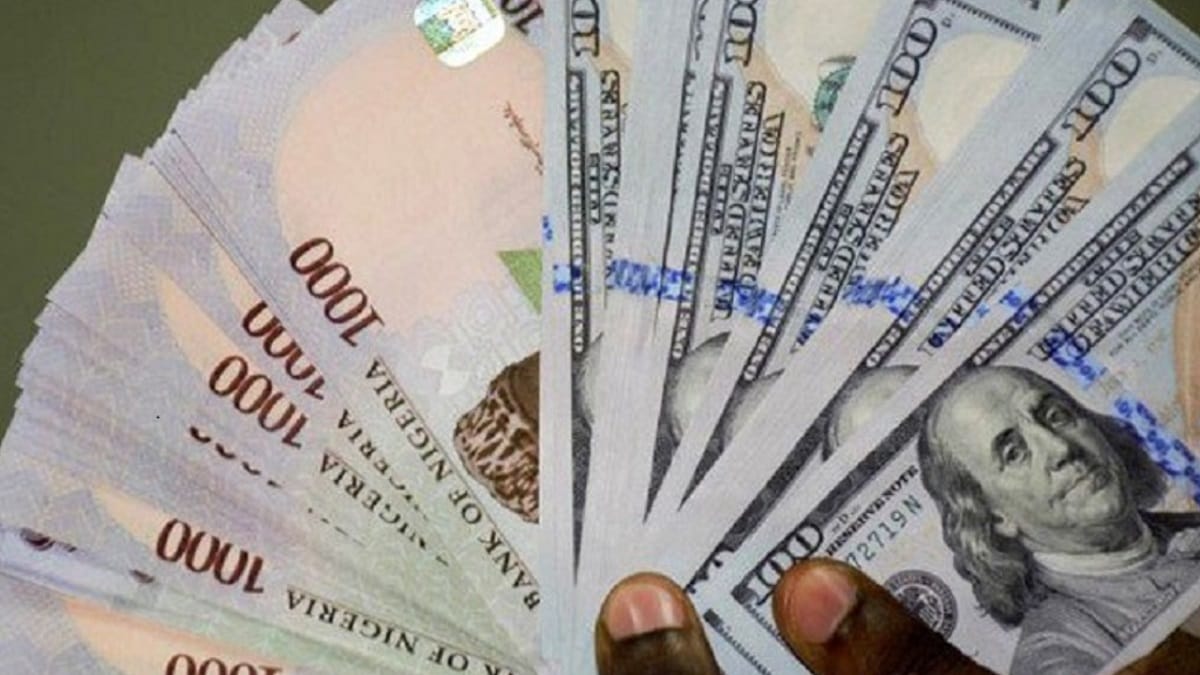
Naira Hits New Low as CBN Stops Market Intervention
The Nigerian naira traded on a grumpy bearish line as the exchange rate re-crossed N1,000 as high demand for the US dollar eclipsed the supply side.
At the Nigeria Autonomous Exchange rate, the local currency was exchanged at N1,035.12 against the greenback as manufacturers and other invisible users’ FX logs jerked up.
The exchange rate has been predicted to worsen due to the absence of the apex bank to intervene in the official market, a move that appears to be part of a new currency management regime.
Data from the FMDQ showed that the Naira weakened by 4.72% against the US dollar, closing at N1035.12 per dollar in the official market. In the parallel market, the Naira depreciated by 0.41% day-on-day, closing at N1,215 per dollar.
Analysts told MarketForces Africa that early year demand for foreign currency would have a negative run effect on the exchange rate. There have been predictions across Broadstreet that the local currency would hit the bottom of the rock without strong forex inflows into the economy.
In the global commodity market, West Texan Intermediate (WTI) crude futures rebounded 1.8% to $71.67 per barrel on Wednesday, prompted by signs of supply disruption in Libya, where protests led to the shutdown of the country’s largest oil field, Sahara.
This field had been producing approximately 300,000 barrels per day. Also, the Brent Crude closed at $77.10 per barrel. Last week, the NAFEM rate traded within the range of N700-N1,248/USD but closed at N907.1/USD.
This points towards a depreciation of -2.4% or N21.2 week on week. In the forwards market, fx traded within the range of N897.0-N1201.9/USD. BUA Reduces Cement Price, Plans Further Review
In the 1-month contract, the exchange rate appreciated by +2.0% to close at N975.3/USD, and in the 3-month contract, fx appreciated by +2.3% to close at N994.3/USD.
“Based on our channel checks, we note that in the parallel market, the Naira closed at an average of N1,215 on Friday. Therefore, the gap between the NAFEM and the parallel market rate is 33.9%”, Coronation Research said.
According to data from FMDQ, NAFEM turnover decreased by -54.6% or -USD463 million to USD385.8 m on Friday.
The NAFEM window recorded an inflow of USD 32.9 million. There were no injections made by the CBN – for the tenth consecutive week.
However, foreign portfolio investors (FPIs) accounted for 14.8%, non-bank corporates accounted for 53.1%, exporters accounted for 19.8%, and others accounted for 12.4% Nigeria’s external reserves remained unchanged to close at USD32.8.
