

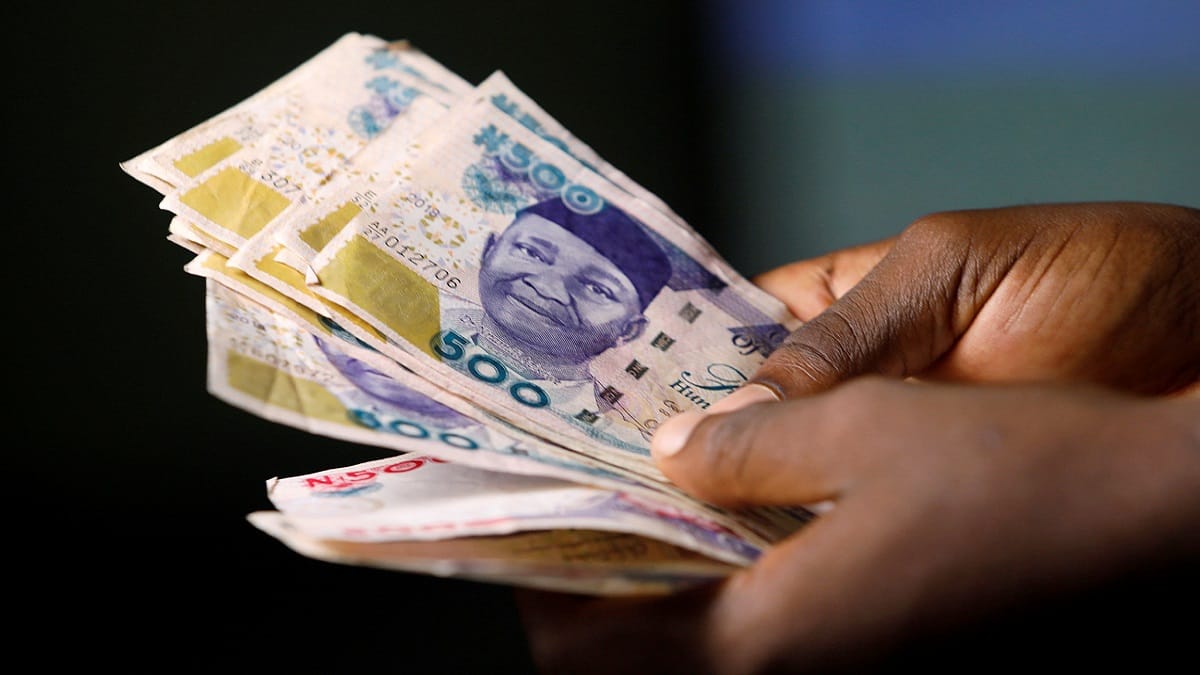
Naira Lost Against U.S. Dollar Across FX Markets
The Nigerian local currency, Naira, keeps losing battle to a stronger, better positioned by economic base and productivity United States dollar in the foreign exchange markets despite Central bank supports, which some analysts see as too low amidst strong demand for foreign currencies in Nigeria.
At the Investors and Exporters foreign exchange market on Thursday, the naira depreciated by 0.19 per cent as the dollar was quoted at N415.05 against the last close of N414.25 as demand outpaced foreign currencies supply.
Most participants maintained bids between N405.00 and N444.00 per dollar, according to the FSDH Capital note. Last week, the Nigerian Autonomous Foreign Exchange Fixing (NAFEX) rate traded within the range of N404 – N452.2 to a dollar but closed at N415.1.
This points towards an appreciation of 0.1% or N0.4 in the week, according Coronation Research note. In the forwards market, FX traded within the range of N418.4 – N446.0.
However, in the 1-month contract, the exchange rate remained unchanged to close the week at N416.1 for a United States dollar. Meanwhile, in the 3-month contract, the exchange rate appreciated by 0.01% to close at N421.3 for a dollar.
In the retail secondary market intervention sales (SMIS) market, the FX spot rate remained unchanged, closing the week at N430.0 after about 13% devaluation by the CBN from N380 in the recent time.
In the parallel market, the Naira closed at an average of N565.0 on Friday. The Nigerian local currency traded at N575 naira per dollar on the parallel market on Thursday.
In the official market, commercial banks quoted the currency in a range of 412 and 415 against the dollar.
As of Friday, the gap between the NAFEX and parallel market rate is 36.1%., Coronation Research said in a note. Analysts said based on data from the FMDQ, NAFEX turnover showed a decline from USD103.0 million to USD84.4m on Friday.
Last week, the I&E (NAFEX) window recorded inflows of USD459.2 million with the CBN accounting for 36.8%, FPIs accounting for 11.4%, non-bank corporates accounting for 29.9%, and others accounting for 21.9%.
Thus, FPIs have historically supported supply levels in the Investors and Exporters FX Window, according to Cordros Capital. Analysts estimated 53.8% of FX inflows to the Investors and Exporters window in 2019, saying this level will be needed to sustain FX liquidity levels.
“We think further adjustments in the exchange rate peg closer to its fair value and flexibility in the exchange rate would be significant in attracting foreign inflows back to the market”, Cordros Capital analysts said in a report.
Last week, Nigeria’s external reserves declined by -0.5% or USD197.3 million to USD40.9 billion, and as of December 14, it has dropped off to $40.73, according to data from the CBN website.
“We note that the CBN can continue to support the FX market. However, to ensure sustained foreign currency liquidity over the medium to long term, attracting foreign inflows remains critical”, Coronation Research said in a report.
Analysts noted that crude oil production levels are currently below the FGN’s preferred production target as seen in the national budget.
Coronation Research expects the NAFEX rate to trade range-bound N412.0 – N420.0 per dollar in the near term. “In our opinion, the CBN has enough supply to support the FX market over the short term, given inflows from the recently issued Eurobond and the IMF’s SDR”, Cordros Capital said in a note.
Turning to the Chinese Yuan (CNY), according to data from the CBN, the Naira depreciated by 0.3% to close at N64.8/CNY.
A slew of analysts’ consensus about the current position has been that foreign inflows are paramount for sustained FX liquidity over the medium term.
In its nascent state, Nigeria manufacturing sectors and other related industries are thriving behind the global level, thus Africa’s largest but growth-starved economy is still trending behind. As a result, export earnings has been low, while import bills continue upward trajectory – thus creating an unfavourable trade balance.
Data from the National Bureau of Statistics on foreign trade in the third quarter of 2021 shows that Nigeria records N5.13 trillion inflow from exports while the nation’s import bill printed at N8.154 trillion.
MarketForces Africa concluded at a recent forum that there is a two-way solution, Nigeria would have to either reduce importations or export more to earn healthy foreign currency that would keep the nation’s net FX position positive. #Naira Lost Against U.S. Dollar Across FX Markets
Read Also: Naira Falls as Dollar Volume Traded at Investors Window Slides
