

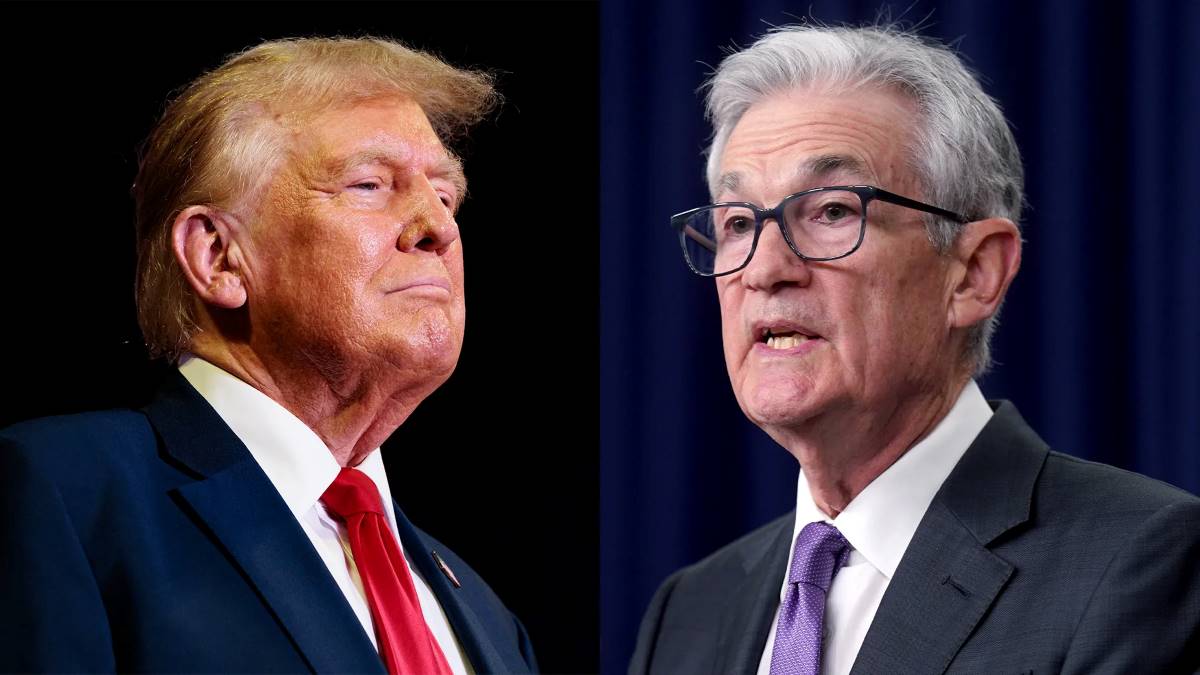
Trump vs Fed fight escalates—markets won’t stand for it, CEO warns
The independence of the Federal Reserve, the world’s largest economy’s central bank, is under attack, and markets won’t stand for it, warns the CEO of one of the world’s largest independent financial advisory organisations.
The warning from Nigel Green of deVere Group comes as Chairman Jerome Powell says he is now under federal criminal investigation related to the $2.5 billion renovation to the central bank’s headquarters and his congressional testimony about that.
The deVere Group CEO says: “This appears to be thinly veiled pressure on the Chair from the pressure about interest rates, which Trump has long been championing to be cut, and not about a refurb at the Fed’s HQ.”
He continues: “Using legal mechanisms to lean on the leadership of the Federal Reserve crosses a line that matters enormously to markets.
“Investors price assets on the assumption that US monetary policy is set by economic evidence, not by political will. When that assumption weakens, risk rises everywhere, immediately and visibly.”
Stock futures for the Dow Jones, S&P 500 and Nasdaq all declined sharply as traders priced in the heightened risk around monetary policy uncertainty and institutional credibility.
Safe-haven assets surged as confidence in traditional monetary guardrails wavered. Gold prices hit historic highs, climbing above $4,600 per ounce as investors sought refuge from political risk surrounding central bank autonomy.
The US dollar weakened as well, with the dollar index falling and losses against major currencies, including the euro and Swiss franc, signalling diminished confidence in the world’s dominant reserve currency amid concerns about monetary policy credibility.
Nigel Green comments: “Central bank independence stands at the core of financial stability. “It protects long-term economic health from short-term political cycles.
“Once political pressure begins to shape interest-rate decisions, inflation expectations become unanchored, bond yields rise to compensate for uncertainty, and stock markets face higher volatility across the board.”
Tech and growth stocks, which depend heavily on predictable discount rates, become more vulnerable to sudden repricing. Banks and insurers face wider spreads as confidence in monetary discipline softens.
Property and infrastructure projects, built on long-dated financing models, confront higher capital costs almost overnight. “No major sector escapes when credibility in monetary governance comes under strain,” warns the deVere CEO.
“Global consequences follow fast. The Fed sets the tone for financial conditions far beyond US borders. Capital flows into Europe, Asia and emerging markets respond directly to Fed signals.
“When those signals appear subject to political pressure, currencies in Latin America and Southeast Asia weaken, borrowing costs rise for governments and companies carrying dollar debt, and financial stress intensifies in economies least able to absorb shocks.”
The dollar’s position as the world’s reserve currency depends on institutional trust.
“The trust is grounded in the belief that the Fed acts independently to safeguard price stability and financial resilience,” says Nigel Green.
“History teaches that countries that allow political leaders to dominate central banks pay a heavy economic price.
Inflation becomes harder to control, currency credibility erodes, long-term growth slows as investment retreats and living standards suffer as purchasing power declines and financial volatility rises.”
He affirms: “Federal Reserve independence is not an abstract principle debated only in academic circles.
“It directly shapes mortgage rates for American households, borrowing costs for global corporations, the health of pension funds, and the stability of banking systems worldwide. Weakening that independence puts all of those at risk simultaneously.
“International investors and central banks hold trillions of dollars in US assets because they trust the institutional strength behind them. Once doubt enters that equation, diversification accelerates.
“Capital begins to look for safer jurisdictions where monetary policy is insulated from political influence. Such shifts alter global financial architecture in ways that are difficult to reverse.”
Markets tolerate political theatre. Markets do not tolerate interference in monetary policy. When legal pressure appears to be applied to influence rate decisions, confidence erodes rapidly. Rebuilding that confidence takes years, sometimes decades.
“The Federal Reserve remains a cornerstone of the global financial system. Its authority underpins stability across equities, bonds, currencies and commodities. Its credibility supports growth in both developed and emerging economies.
“Any sustained attempt to weaken that authority carries consequences far beyond Washington,” concludes the deVere CEO. Naira Rallies Ease Corporate Foreign Payments Burden
