

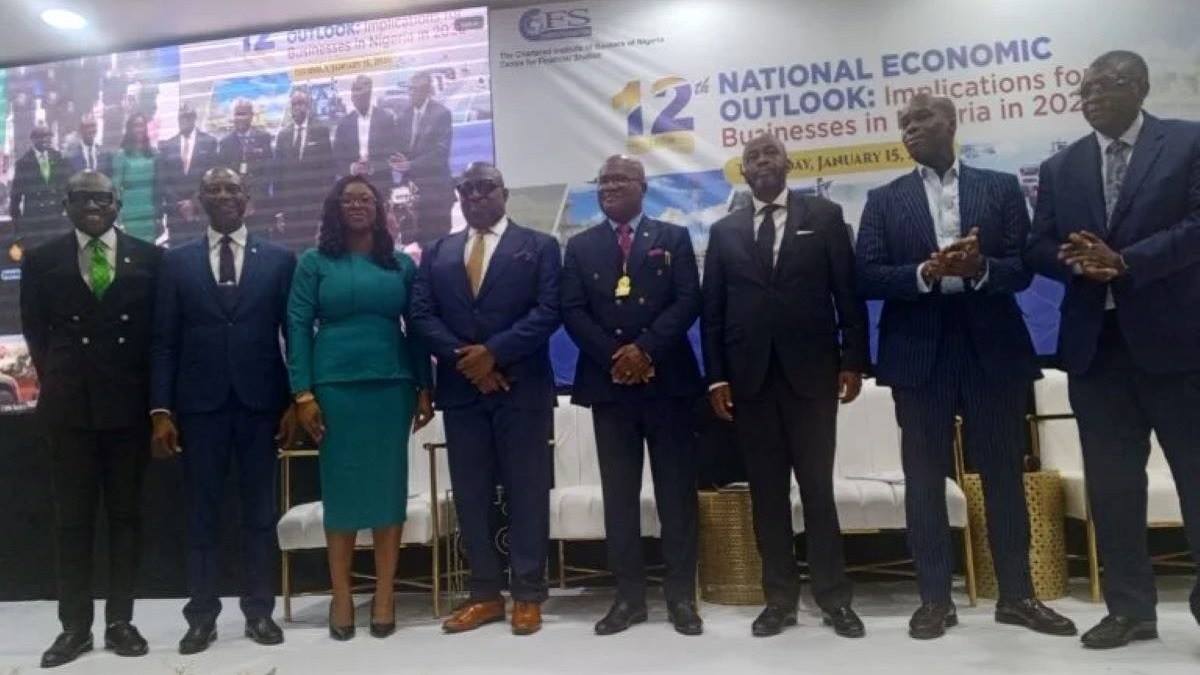
CBN, Nigeria’s Finest Economists Project Faster GDP Growth for 2026
The Central Bank of Nigeria (CBN) and leading economists have projected stronger economic or gross domestic product (GDP) growth and lower inflation in 2026, citing improved macroeconomic fundamentals and reform impacts.
The projection was made on Thursday at a hybrid roundtable organised by the Chartered Institute of Bankers of Nigeria Centre for Financial Studies with B. Adedipe Associates.
The Lagos event was the theme ’12th Edition National Economic Outlook: Implications for Businesses in Nigeria in 2026′. CBN Deputy Governor, Economic Policy Directorate, Dr Muhammad Abdullahi, said real GDP growth was projected at 4.49 per cent in 2026.
He added that inflation was expected to moderate to 12.94 per cent, reflecting easing pressures and reform outcomes.
Abdullahi said the outlook was supported by non-oil sector expansion, improved crude oil output, rising private investment and a more stable macroeconomic environment. He said Nigeria recorded a balance of payments surplus of about 3.81 billion dollars in 2025, reversing deficits from the previous two years.
According to him, foreign exchange conditions would remain broadly stable due to FX reforms, higher oil receipts, diaspora remittances and stronger investor confidence.
“External reserves are projected to exceed 50 billion dollars in 2026,” he said, adding that inflation would continue easing. He attributed the trend to lower food and energy pressures and the lagged effects of monetary tightening.
Abdullahi, represented by Dr Victor Oboh, Director, Monetary Policy, said the apex bank would sustain reforms to strengthen price stability and external sector resilience. He urged banks to expand credit to productive sectors, including manufacturing, agribusiness and small and medium enterprises.
Keynote speaker Prof. Biodun Adedipe, Chief Consultant of B. Adedipe Associates Ltd ., said the economy was expected to perform better in 2026 than in 2025. He described 2026 as a stabilisation year marked by exchange rate stability, declining inflation, rising reserves and strong stock market performance.
Adedipe said Nigerians were already feeling reform impacts, noting easing prices of some staple foods. He called for sustained policies to boost production, particularly agriculture, to further reduce inflation.
Also speaking, Dr Baba Musa, President of the Nigerian Economic Society, said Nigeria’s economic fundamentals were improving, but outcomes depended on reform execution.
“Effective monetary, fiscal and tax reforms will determine 2026 outcomes,” he said, urging businesses to invest in capacity, technology and markets. Earlier, Prof. Pius Olanrewaju, Chairman, Council of the CIBN, said the forum set the tone for economic policy dialogue in 2026.
He said new tax reforms effective Jan. 1 would broaden the tax base, strengthen public finances and reduce oil dependence, while protecting small businesses and low-income earners.
Naira Climbs to N1,419 Per Dollar as Foreign Reserves Surge
