

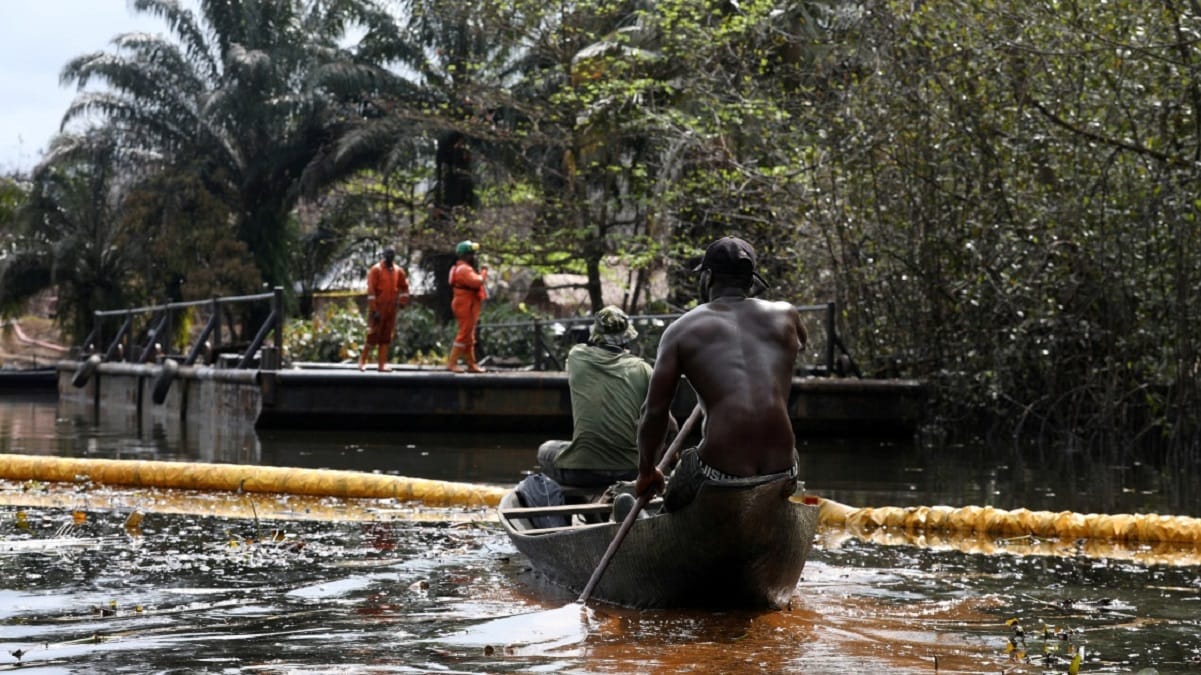
Black Soot, Environmental Degradation, Poverty: Is Oil Discovery a Curse for Niger Delta People?
With a maximum crude production capacity of 2.5 million barrels per day, Nigeria boasts as the largest oil producer in Africa and the 13th largest oil-producing country in the world. Oil proceeds account for around 65% of government revenue.
Over its 5 decades of crude oil exploration, Nigeria has made tens of billions of dollars from oil sales. But despite the huge revenue, oil host communities reek of poverty and many other economic and humanitarian problems, which include regular occurrences of black soot, water, and plant degradation, gas flaring, and oil spills from pipelines, and unemployment/underemployment.
Most of these are recurring problems they have suffered for decades without a lasting solution. The health and economic implications of these issues constitute a serious burden on residents, especially children and the elderly.
For example, black soot, which is gradually becoming a permanent menace in many Niger Delta communities, has been linked to the increase in adverse skin, respiratory, and reproductive disorders. A 2019 report showed that these black soot-related health conditions are responsible for an estimated 25,000 deaths in the area.
Soot is a deep black powdery substance that consists largely of amorphous carbon, resulting from the incomplete burning of organic matter. Its tiny size makes it easy to penetrate the lungs and bloodstream, causing serious health implications. The United States Environmental Protection Agency describes it as one of the deadliest forms of air pollution.
A recent investigation conducted by The Cable shows that many residents in the affected areas suffer conditions ranging from “depressed to seriously depressed lung function activities.” Health experts say the soot-related conditions could also result in lung cancer and bronchitis for adults while children stand the risk of suffering from pneumonia.
It has been a recurring issue in the Niger Delta for years. In 2016, there was a nationwide uproar following the constant prevalence of black soot in Rivers State. In 2018, a technical team was commissioned to unravel the causes behind the 2016 occurrence.
Findings from the committee show that gas flaring and illegal bunkering were the major factors responsible for the crisis. It was also reported that there was a 30% increase in morbidity and mortality rates in the states 16 months after the 2016 soot incident.
Despite the devastating impacts, there seem to be no measures to prevent a reoccurrence as the region started experiencing the issue again in 2021, and many communities are still plagued with the health and environmental effects to date.
In the past few months, the condition has become much escalated, and pictures gathered from the area are devastatingly worrisome.
According to the Niger Delta Vigilante (NDV) findings, the recent development is largely linked to the upsurge in what is popularly known as Kpo-fire, a shady but thriving oil bunkering business in the region.
Kpo-fire refers to the local oil process of heating the crude in a fabricated oven to extract petroleum products while its residual is released into the environment, not minding the implication on the ecosystem.
Other factors said to be responsible include the practice of setting ablaze crude oil sites by some contractors as a way of cleanup and the burning of stolen crude seized by security operatives.
Immigration Advice Service spoke with some residents in Port Harcourt, Rivers, another state in the Niger Delta, who decried the health and environmental impact of the black soot.
“The soot has been a big problem to the environment. In my home, we don’t open our windows or doors because the place gets dirty almost immediately after we clean up,” Mildred Alerechi, a health style coach, told IAS correspondent. “My nails are also dirty for no reason; the soot finds its way into my fingernails.”
There has been a persistent outcry on the sheer negligence by the state and federal governments to their plights. Unfortunately, concerned authorities have not responded to people’s call to end the menace.
Another resident who spoke with IAS said: “To the best of my knowledge, no concrete action has been taken yet; I’m sure they [the government] are aware of the root cause and can tackle the problem if they want to.”
According to a Wikipedia report, “The advent of oil production has also negatively impacted the Niger Delta region due to unprecedented oil spillage which has been ongoing for the past 5 decades making the region one of the most polluted in the world.”
The stinking corruption in the government agencies established to ensure the rights of Niger Delta people has further contributed to the ongoing ecocide.
A report by the Nigerian National Petroleum Corporation (NNPC) back in 1983 revealed that “the slow poisoning of the waters of this country and the destruction of vegetation and agricultural land and good water source by oil spills which occur during petroleum operations.
But since the inception of the oil industry in Nigeria, more than fifty years ago, there has been no concerned and effective effort on the part of the government, let alone the oil operators, to control environmental problems associated with the industry.”
Many decades after, oil companies still play the blame game on who should be held responsible for the environmental consequences of the oil production in the region. Recently, a Dutch Appeal Court based in the Hague, Netherlands, found the Shell Petroleum Development Company (SPDC) culpable for farmlands and fishponds pollution in the Niger Delta region.
Despite the court order mandating SPDC to pay compensation to the affected farmers for the damages, the oil company insisted that the said damages were caused by sabotage, and it should not be the one to bear the brunt.
It took about a year before the oil giant started a mediation process with the aggrieved farmers for an out-of-court settlement. It is left to be seen if both parties would finally reach an agreement on the right amount to be paid by the company.
Economically, most oil-producing communities in Niger Delta are poverty-stricken, plagued with a high unemployment rate, and lack many basic social amenities such as potable water, electricity, motorable roads, hospitals, and a conducive learning environment for school children.
As the communities suffer all these plights, paradoxically, foreign and local oil companies and politicians benefit hugely from oil sale proceeds. Pollution from leaking pipelines, illegal bunkering, gas flaring, and other unwholesome activities have rendered many farmers and fishermen jobless as their livelihood continues to be affected by oil exploration.
“The by-products are usually dispensed into the rivers and on farmlands. Let’s take Ogoni as a case study, the oil spill has stopped fishing activities in that area, and it’s bad,” Michael Ndukwu, a University of Port-Harcourt student told IAS.
Though unemployment is a general issue in Nigeria, the case in Niger Delta seems peculiar due to certain factors, which include the environmental degradation resulting from oil exploration affecting fishing, farming, and other commercial activities in the region.
In a report that explored the causes of poverty and high unemployment rate in the Niger Delta region of Nigeria, Dr E.D Simon, a researcher at the Department of Mass Communication, Cross River University of Technology Calabar, noted that the “Oil and mineral extraction in the region promoted the looting tendency by various government in Nigeria and have linked with unusually high poverty rates, poor health care and high rate of mortality.
“This means in effect that sustainable development can hardly be achieved under this unfavourable and in a secured environment”.
The cost of living in the region is relatively higher compared to most other regions in the West African country. This makes wages and salaries of the employed residents insufficient, as they could best be described as underemployed.
While the huge cost of food transportation/importation usually increases feeding expenses among Nigerians, the burden is more troubling on Niger Delta residents, as they could barely source food items locally due to the persisting damage on farmlands and waters.
They, therefore, depend more on imported food items and those transported from other parts of the country. This further renders them underpaid even when placed on a similar salary structure as people from other regions.
While other oil-producing countries like Saudi Araba and UAE use the proceeds to develop their countries, oil discovery and exploration seem to be a curse for the host communities in Nigeria.
There is a great concern that if no decisive action is taken, oil exploration could cause an ecological disaster, which could lead to a humanitarian catastrophe in the host communities in Nigeria.
Olusegun Akinfenwa is a political correspondent for Immigration Advice Service, a UK based law firm that offers immigration services globally, including the US Citizenship and Immigration Process. Most of his work revolves around spreading awareness about the harsh socio-political realities confronting African society, with a view to bringing lasting solutions to them.
