

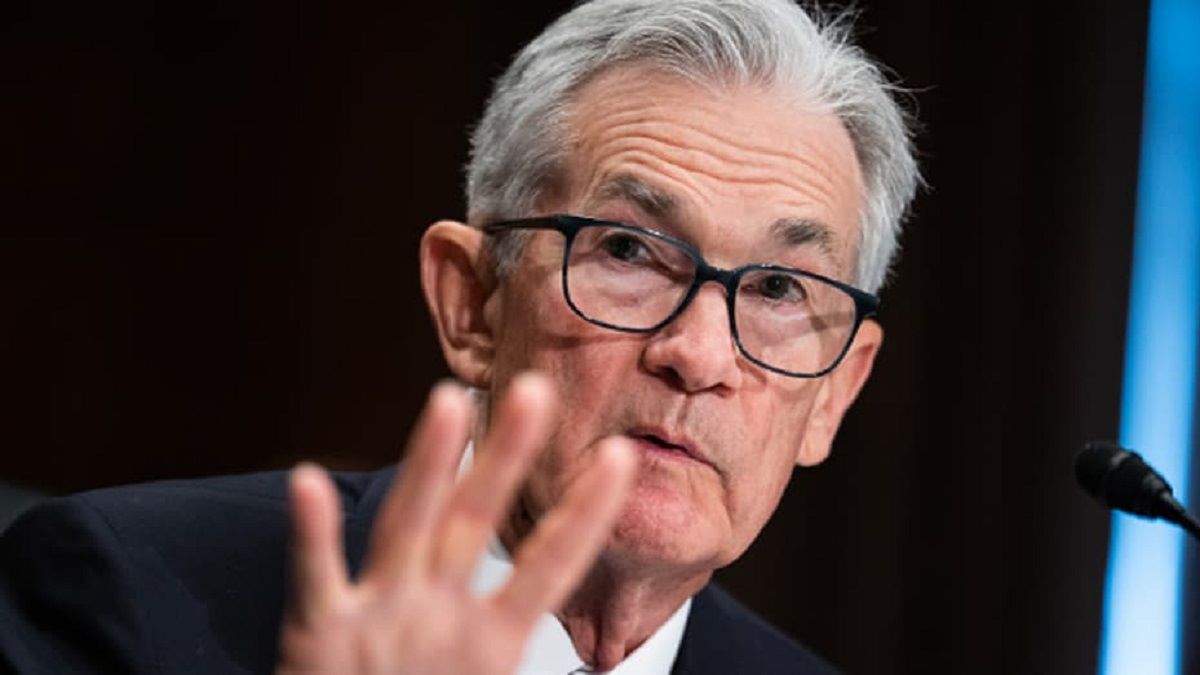
US Fed Chair Jerome Powell Confirms September Rate Cut
US Federal Reserve chair, Jerome Powell has confirmed the September rate cut, details from his speech delivered on Friday revealed. In his speech, Powell said the Federal Open Market Committee’s (FOMC) primary focus has been on bringing down inflation, and appropriately so.
US Fed chair said prior to this episode, most Americans alive today had not experienced the pain of high inflation for a sustained period.
Inflation brought substantial hardship, especially for those least able to meet the higher costs of essentials like food, housing, and transportation, Fed Chair said. He noted that high inflation triggered stress and a sense of unfairness that linger today.
“Our restrictive monetary policy helped restore balance between aggregate supply and demand, easing inflationary pressures and ensuring that inflation expectations remained well anchored. Inflation is now much closer to our objective, with prices having risen 2.5 percent over the past 12 months.
“After a pause earlier this year, progress toward our 2 percent objective has resumed. My confidence has grown that inflation is on a sustainable path back to 2 percent”, Powell said.
On employment, Fed chair stated that labor market conditions are now less tight than just before the pandemic in 2019—a year when inflation ran below 2 percent.
“It seems unlikely that the labor market will be a source of elevated inflationary pressures anytime soon. We do not seek or welcome further cooling in labor market conditions.”
Overall, Powell said the economy continues to grow at a solid pace. But the inflation and labor market data show an evolving situation.
The upside risks to inflation have diminished, he noted. And the downside risks to employment have increased. Powell said FOMC is attentive to the risks to both sides of our dual mandate.
“The time has come for policy to adjust. The direction of travel is clear, and the timing and pace of rate cuts will depend on incoming data, the evolving outlook, and the balance of risks”, he added.
In a commentary note, ING affirmed that September interest rate cut is coming with Fed Chair Powell telling us that “the time has come for policy to adjust. The direction of travel is clear, James Knightley, international economist at ING.
The market favours it being a 25 basis point move, but the 6 September jobs report will determine what happens. They don’t want further weakness so another rise in unemployment to 4.4% or 4.5% could trigger a 50bp move, Knightley said,
“We get the usual bits and pieces about inflation looking better and the focus is now much more on jobs, but he is as categorical as he can be with the statement “The time has come for policy to adjust”.
Economist said the direction is clear. This follows on from the minutes to the July FOMC meeting, released on Wednesday, which said “the vast majority of FOMC members observed that, if the data continued to come in about as expected, it would likely be appropriate to ease policy at the next meeting.
There is no discussion of 25bp or 50bp at the September FOMC meeting – merely which “the timing and pace of rate cuts will depend on incoming data, the evolving outlook, and the balance of risks”.
Nonetheless, he does allude to the fact that they could cut rates a lot should conditions warrant it – “The current level of our policy rate gives us ample room to respond to any risks we may face, including the risk of unwelcome further weakening in labor market conditions.”
There is currently around 33bp of cuts priced for the 18 September FOMC meeting and 100bp by year-end with a further 125bp of cuts next year, Knightley said.
ING economist explained that that looks fair given the current situation between now and the 18 September decision the markets have the core PCE deflator, which the market is confident on a 0.2% month-on-month print given the inputs from CPI and PPI.
Then it is the jobs report on 6 September and that is the critical one. Note Powell today stated that “we don’t seek or welcome further cooling in labour market conditions”.
“If we get a sub 100,000 on payrolls and the unemployment rate ticking up to 4.4% or even 4.5% then 50bp looks more likely. If payrolls comes in around the 150,000 mark and unemployment rate stays at 4.3% or dips to 4.2% we can safely say it will be a 25bp”, Knightley said,.
Then on 11 September it is core CPI. 0.2% month-on-month or lower looks likely there – ING analysts are currently leaning in the direction of a possible 0.1% on the potential for the jump in July primary rents to reverse. U.S. Govt. Announces $27m Humanitarian Aid for Nigeria
